Search for Crackstube today and you may find several very different explanations. Some pages describe a digital publishing website, while others discuss streaming, unofficial downloads, or cracked software. Treating all of those references as one service creates more confusion than clarity.
The safest starting point is that Crackstube is an ambiguous online term. One specific domain, CracksTube.com, currently presents itself through publicly indexed information as a digital-media and publishing website. Other pages use the same or a similar name differently, and there is not enough evidence to assume that all of those websites share the same owner or operation.
What Is Crackstube?
There is no well-supported reason to define every use of the name as one company, platform, or website.
Current search results show several interpretations. The .com domain is associated with written articles, digital publishing, and guest-posting opportunities, while separate third-party pages connect the broader term with unofficial streaming or software-related websites.
These descriptions may be talking about different entities.
The most useful rule is simple:
When a claim is made about Crackstube, check which exact website address the claim concerns.
Why Does the Name Mean Different Things in Search Results?
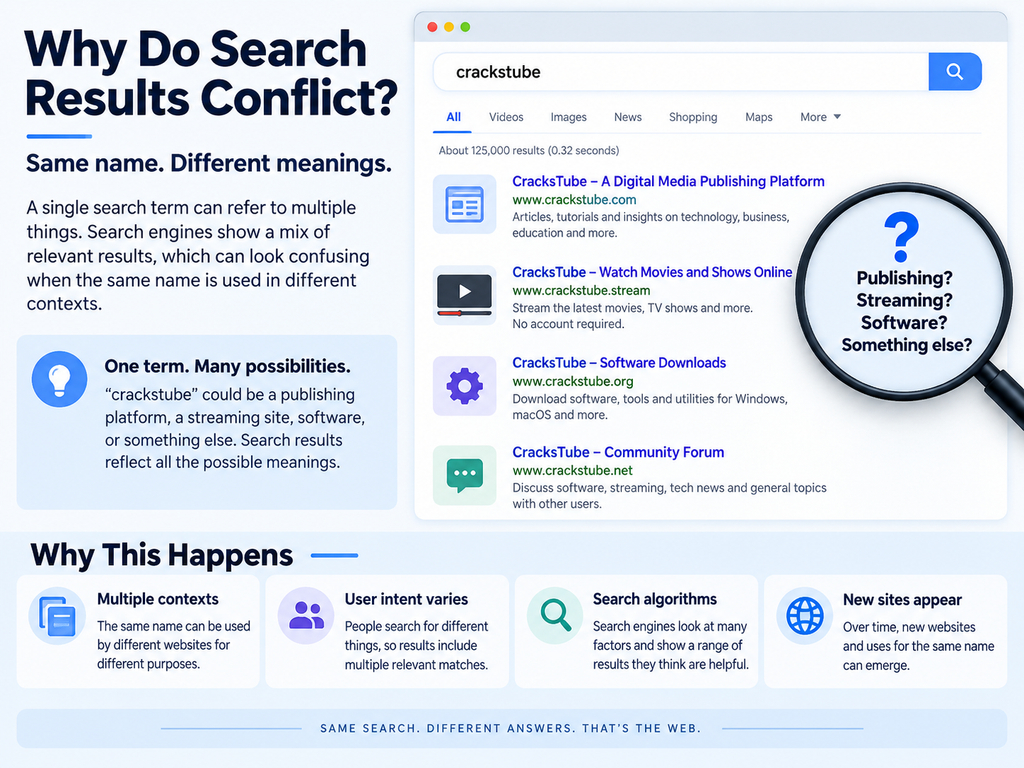
Search engines organize pages according to words, entities, links, relevance, and user intent. When the same or very similar branding appears in different contexts, results can mix several interpretations.
That is what appears to be happening here.
Some recent pages distinguish the publishing-oriented .com domain from unrelated references involving streaming or software. Older or differently framed articles may use the word more generically.
This does not prove that one explanation is secretly the “real” meaning. It simply means the name is not reliable enough on its own to identify an operator.
What Is CracksTube.com?
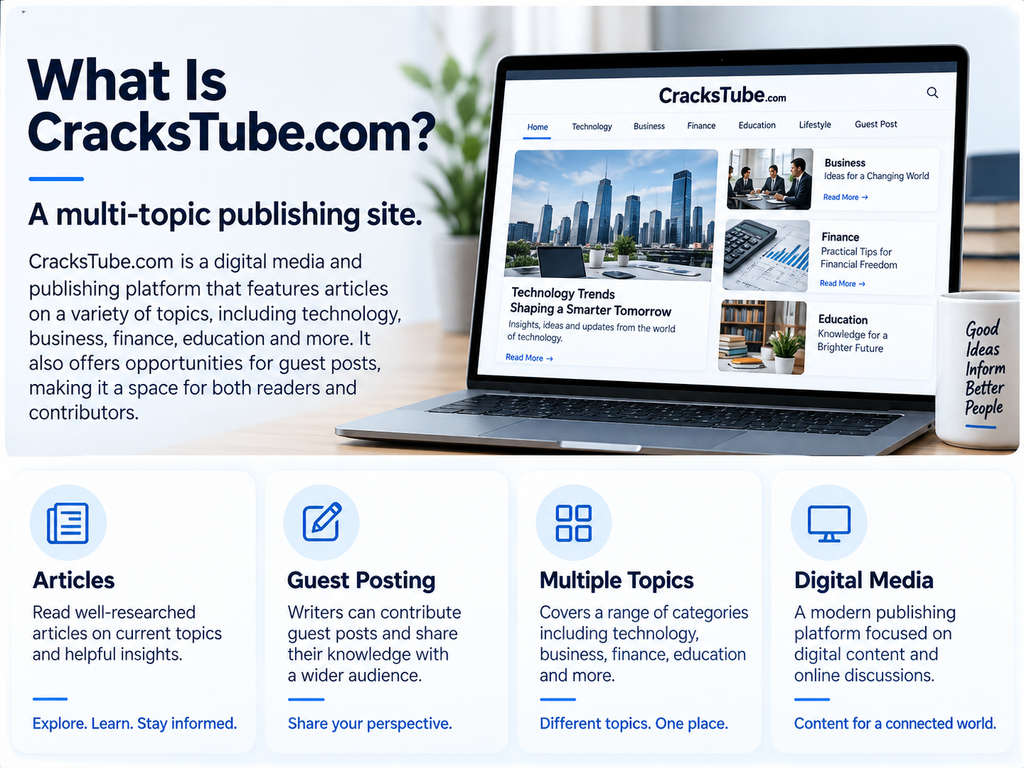
CracksTube.com is the exact .com domain most clearly associated with the publishing interpretation.
The homepage could not be directly retrieved during the September 14, 2026 research because it returned a 403 response. That limits what can responsibly be claimed about its exact current layout, policies, or user experience.
There is nevertheless direct evidence that the domain has hosted conventional written articles. Indexed pages show a normal article structure with publication dates, authorship, and category information.
Current technical metadata also describes the site using digital-media and guest-posting language, with subjects including technology, finance, education, and business.
The careful conclusion is therefore:
The website currently presents itself as a multi-topic publishing and digital-media site.
That is different from claiming it is the “official” version of every similarly named property online.
What Does the Website Publish?
Public descriptions associate the site with broad informational subjects rather than one narrow editorial niche.
Commonly mentioned areas include technology, finance, business, and education, while some secondary descriptions list additional lifestyle and professional topics.
Because direct access to the current homepage was unavailable during research, these category descriptions should be treated as the site’s public positioning rather than a complete independently audited inventory.
Readers should also evaluate individual articles on their own merits. A general-interest publication covering many subjects should not automatically be treated as an expert authority on every topic it publishes.
Important claims should still be checked against specialists, primary sources, and current evidence.
Does the Platform Offer Guest Posting?
Guest posting appears to form part of the site’s public positioning.
Current metadata and multiple third-party descriptions indicate contributor or guest-post opportunities, although the latest submission process could not be independently inspected during this research.
That establishes considerably less than some marketing language may imply.
A guest post does not guarantee:
- Google rankings
- increased authority
- referral traffic
- indexing
- valuable backlinks
- permanent placement
Google recommends qualifying paid placements with appropriate link attributes, with rel="sponsored" preferred for advertising and paid links. Its spam policies also identify buying or selling links for ranking manipulation as link spam.
Anyone considering a paid placement should therefore evaluate editorial standards, disclosure, audience relevance, link treatment, and publication terms rather than purchasing solely for a promised SEO benefit.
Why Is the Name Associated With Streaming or Cracked Software?
Part of the confusion comes from third-party articles that use the term differently.
AQVIZ, for example, describes Crackstube as a label associated with unlicensed streaming, adult media, and sometimes cracked software. Other websites also use “Crackstube-style” language when discussing piracy or software risks.
The important question is not whether those articles exist. They clearly do.
The question is whether they establish that the specific .com publishing domain operates those services.
The evidence reviewed for this article does not establish that connection.
AQVIZ largely discusses a generalized class of platforms rather than demonstrating ownership or operational links between the publishing site and a specific streaming, piracy, or cracked-software service.
For that reason, it would be inaccurate to label the publishing domain a piracy site merely because another page uses the keyword in that context.
Are Those Websites Actually Connected?
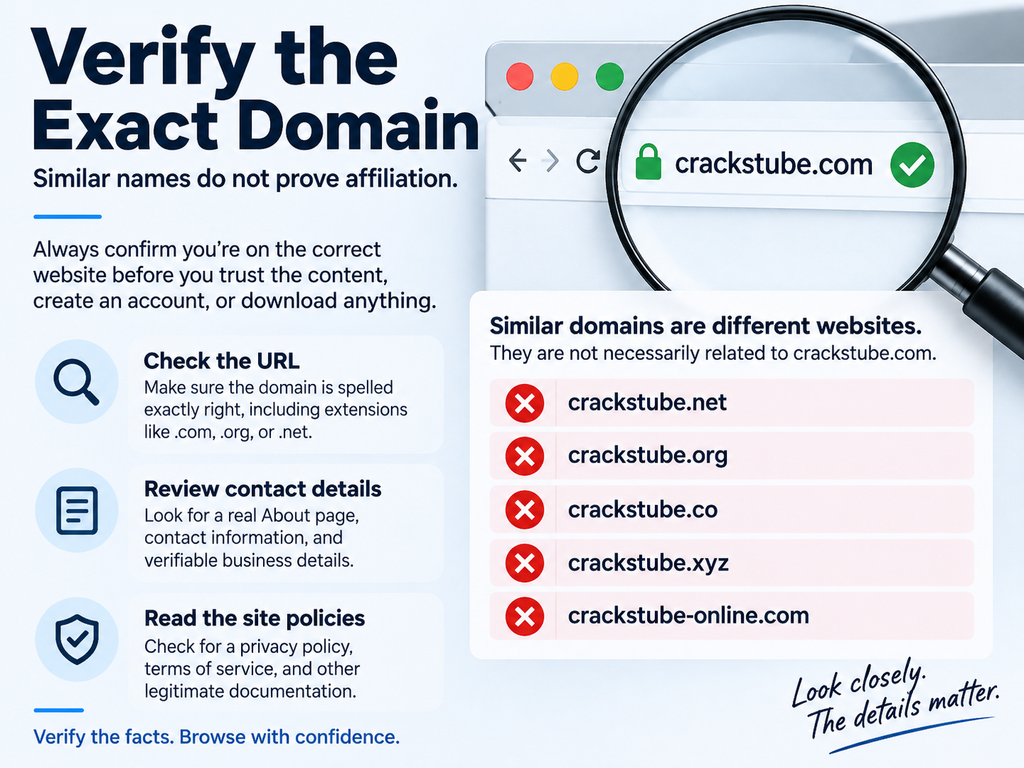
No connection should be assumed without evidence.
Similar names can result from independent businesses choosing comparable branding, historical domains, copied branding, keyword-focused sites, third-party articles using a term generically, or search engines matching several meanings to one query.
A shared word in a domain name does not prove shared ownership.
The same applies to logos, article titles, or claims that a website is “official.” Ownership should ideally be supported by first-party corporate disclosures, consistent contact details, or other verifiable records.
Verified vs. Unverified Claims
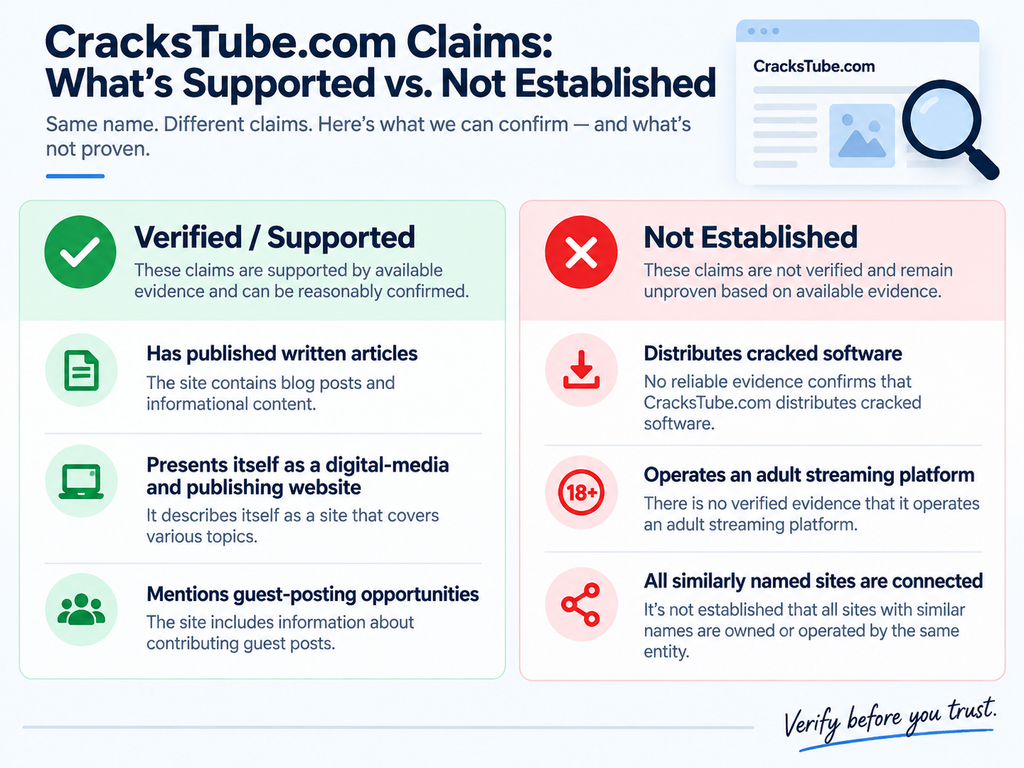
Several commonly repeated claims deserve different confidence levels.
Supported: the .com domain has published written articles, and its public metadata positions it around digital media, publishing, and guest posting.
Not established: the publishing site distributes cracked software.
Not established: it operates an adult-streaming platform.
Not established: every similarly named website belongs to the same operator.
Not established: the site is universally safe or unsafe.
Promotional rather than independently demonstrated: broad claims that it has exceptional authority, rapid growth, a loyal audience, or guaranteed SEO value.
OpenPR’s profile of the platform is explicitly labeled a press release. A press release can document what its issuer wants to communicate, but it should not be treated as independent confirmation of every claim it contains.
Why Is There So Much Confusion Around Crackstube?
The conflict appears to come from several ordinary web phenomena rather than one dramatic explanation.
First, the keyword itself is unusual and has been interpreted differently by different publishers.
Second, different websites can use similar branding without belonging to the same business.
Third, promotional content, general explainers, and reputation articles can all rank for the same entity-style query.
Fourth, newer pages may begin responding to older conflicting results, creating a growing group of “what does this really mean?” articles.
By September 2026, that disambiguation angle had itself become a visible part of the search landscape.
How to Verify Which Site You’re Looking At
When you encounter a website using this name or something similar:
- Read the full URL. Similar branding does not prove affiliation.
- Identify its actual purpose. Does it publish articles, stream media, sell something, or request downloads?
- Review About and Contact information.
- Inspect privacy, terms, copyright, and publishing policies where available.
- Check whether normal browsing unexpectedly requires software downloads or extensions.
- Look for independent references to the exact domain, not merely the brand name.
- Check publication and review dates. Websites can change over time.
- Do not assume affiliation from similar names alone.
This exact-domain approach is more reliable than judging a site by a keyword alone.
Is Crackstube Safe?
There is no responsible universal yes-or-no answer because the term does not clearly identify one website.
For CracksTube.com specifically, this research did not perform a malware scan, create an account, or audit the site’s code. It would therefore be inappropriate to certify the domain as safe.
HTTPS alone would not prove safety either.
For any unfamiliar site, pay attention to browser security warnings, forced downloads, unexpected redirects, extension-install prompts, suspicious permission requests, inconsistent branding, unexplained login requests, or unexpected payment demands.
Do not override browser or security warnings simply because a site looks professional.
If a website offers software, download applications from the original developer or an established authorized source whenever possible.
Is Crackstube Legal?
Legality depends on the specific domain, specific material, licensing, user activity, and jurisdiction.
Publishing general informational articles is fundamentally different from distributing unlicensed media or tools designed to bypass software licensing.
The presence of the word “crack” in a brand name does not prove unlawful activity.
Likewise, if a separately operated website distributes unauthorized copyrighted material, its legal status must be evaluated based on that conduct rather than transferred automatically to every similarly named domain.
Final Takeaway
The clearest way to understand Crackstube is to stop treating the keyword as proof of a single entity.
The .com domain currently presents itself as an article-based digital-media and publishing website with guest-posting positioning. Other search results use the same or similar terminology when discussing streaming, piracy, or cracked software, but the evidence reviewed here does not establish that those references belong to the same operator.
Whenever you evaluate a claim, ask two questions first:
Which exact domain is being discussed?
What evidence supports the claim?
Those two checks eliminate much of the confusion surrounding the name.
Frequently Asked Questions
1. What is Crackstube?
Crackstube is an ambiguous online term that appears in different contexts across search results. One specific domain, CracksTube.com, currently presents itself as a digital-media and publishing website, while other pages use similar terminology for unrelated streaming or software-related topics.
2. Is CracksTube.com a publishing platform?
Publicly available information indicates that CracksTube.com has published written articles and currently positions itself around digital publishing, general-interest content, and guest-posting opportunities. This does not mean every similarly named website is connected to the same platform.
3. Is Crackstube safe to use?
There is no universal safety verdict because the name may refer to different websites. Users should verify the exact domain, watch for browser warnings, avoid unexpected downloads or redirects, and review the site’s current reputation before sharing personal information or installing anything.
4. Does CracksTube.com offer guest posting?
Current public information indicates that the website promotes guest-posting or contributor opportunities. However, publishing a guest post does not guarantee better Google rankings, traffic, backlinks, or SEO authority.
5. Why do search results describe Crackstube differently?
Search results can mix different websites, historical references, promotional articles, and third-party interpretations that use the same or similar name. For this reason, the exact domain should always be checked before assuming that two references describe the same business or website.