
A good daily wellness routine does not require waking at 5 a.m., taking a collection of supplements or spending hours on self-care. A balanced routine can include a reasonably consistent sleep schedule, daylight, hydration, nourishing meals, regular movement, short mental breaks, stress management, social connection and a calmer transition into sleep.
You do not have to complete every habit every day. In fact, trying to overhaul your entire lifestyle at once can make the routine harder to maintain. Start with a few actions that fit your life and build from there.
What Is a Daily Wellness Routine?
A daily wellness routine is a repeatable but flexible set of habits that supports your physical, mental, emotional and social wellbeing throughout the day.
The word flexible matters.
Your routine should be able to survive busy workdays, weekends, travel, family responsibilities and the occasional day when very little goes according to plan.
Daily Wellness Routine at a Glance
A practical routine might look like this:
- Morning: wake, get daylight, hydrate as needed, move and eat if you are hungry.
- Daytime: eat balanced meals, break up long periods of sitting, take mental breaks and stay connected with other people.
- Evening: create a boundary around work, reduce unnecessary stimulation and give yourself enough opportunity for sleep.
You can change the timing, order and length to match your life.
A Simple Morning Wellness Routine

Wake at a Reasonably Consistent Time
You do not need a 5 a.m. alarm to have a healthy morning.
What matters more is creating a sleep schedule that is reasonably predictable and gives you enough opportunity to sleep. NHLBI recommends going to bed and waking at similar times as part of healthy sleep habits.
Shift workers, new parents and people with irregular responsibilities may need a very different strategy, so consistency should be treated as a useful goal rather than an inflexible rule.
Get Some Morning Daylight
Open the curtains, step onto a balcony, walk outside or spend a little time outdoors when circumstances allow.
Light is an important environmental signal for your body’s sleep-wake system, and CDC specifically recommends getting natural light, particularly earlier in the day.
There is no need to claim that a precise number of morning minutes will “reset” everyone’s body clock.
And do not use morning daylight advice as a guaranteed vitamin D prescription. Vitamin D production from sunlight varies considerably between individuals and circumstances.
Rehydrate According to Your Needs
You may feel thirsty after sleeping, so having water available in the morning is a simple habit.
You do not need to drink an exact amount immediately after waking, and water does not need marketing claims about “activating” your organs.
Hydration requirements vary according to factors including age, sex, activity and pregnancy or breastfeeding status, and fluids also come from foods and other beverages.
A practical rule is simpler: drink regularly according to your needs and make fluids easy to access during the day.
Add a Little Movement
Your morning movement could be:
- a short walk
- several mobility exercises
- stretching
- yoga
- a workout
- simply walking part of your commute
Choose the version you are likely to repeat.
Adults are generally advised to accumulate at least 150 minutes of moderate-intensity aerobic activity each week, or an equivalent amount of vigorous activity, plus muscle-strengthening activity on at least two days. That weekly recommendation does not mean your wellness routine requires a formal workout every morning.
Eat a Balanced Breakfast If It Works for You
Breakfast is optional, not a moral obligation.
If you enjoy eating in the morning, aim for a meal that keeps nutrition straightforward. Depending on your preferences, that might include a protein source, fiber-rich foods, fruit or vegetables, and whole-grain foods.
Examples could include:
- eggs with whole-grain toast and fruit
- yogurt with oats, nuts and berries
- oatmeal with fruit and a protein-rich accompaniment
- beans, vegetables and whole-grain bread
- leftovers from last night’s balanced meal
Food needs differ between individuals. USDA guidance similarly recognizes different needs according to age, sex, body size, activity and pregnancy status.
Choose Your Priorities for the Day
Before messages and notifications take over, identify one to three things that genuinely need your attention.
You can also choose one personal wellbeing intention such as:
- take a short walk at lunch
- call someone you care about
- stop work at a reasonable time
- take a break before you become exhausted
Keep this step short. This is a wellness routine, not a productivity system.
A Wellness Routine for the Middle of Your Day

Wellness should not disappear between breakfast and bedtime.
For many adults, the middle of the day is where a practical routine matters most.
Break Up Long Periods of Sitting
If your work keeps you seated for extended periods, look for natural opportunities to stand or move.
You could:
- stand while taking a call
- walk to refill your drink
- stretch between tasks
- take a short walk at lunch
- use stairs when suitable
- alternate seated and standing tasks
Current U.S. guidance says adults should move more and sit less, but it does not prescribe one universally proven sitting-break schedule.
That means you do not need an alarm forcing you to stand at an arbitrary interval unless reminders genuinely help you.
Eat Balanced Meals
A healthy meal does not need a detox label, superfood powder or restrictive rule.
Think in broad components instead:
- vegetables and/or fruit
- a protein source
- grains or another suitable carbohydrate source
- fats where appropriate
- enough food for your individual needs
Variety matters more than creating a “perfect” plate every time.
Stay Hydrated Throughout the Day
Keep a drink somewhere convenient if that helps you remember.
Your requirements may change with activity level, climate, diet, pregnancy or breastfeeding and individual health circumstances.
That is more useful than forcing everyone to follow the same bottle-count target.
Give Your Brain Short Breaks
A break does not have to become another wellness project.
Try:
- standing away from your desk
- looking outside
- taking a brief walk
- stretching
- sitting quietly
- getting a drink
- taking a few slow breaths
The objective is simply to interrupt prolonged mental demand.
Protect Your Attention
Technology is useful. Constant interruption is less useful.
You might make your day calmer by:
- turning off nonessential notifications
- checking email at deliberate times when your work allows
- placing your phone out of immediate reach during focused tasks
- closing unnecessary browser tabs
- doing one cognitively demanding task at a time where practical
The aim is intentional technology use, not fear of screens.
Wellness includes relationships.
A small dose of meaningful connection could mean:
- eating lunch with someone
- speaking with a colleague
- messaging a friend
- calling a family member
- spending time with a community group
Social connection is recognized by the U.S. Surgeon General as an important component of health and wellbeing.
Quality matters more than accumulating a large number of interactions.
Check In With Your Stress Level
When you notice yourself becoming tense, irritable or mentally scattered, try a quick check:
What do I need right now?
Maybe it is:
- movement
- food
- water
- rest
- support
- quiet
- a short break
This is a self-awareness exercise, not a diagnostic tool.
Slow breathing or another relaxation technique can be an optional tool. Evidence suggests relaxation practices may help with stress, but they should not replace appropriate professional care.
A Simple Evening Wellness Routine

Create a Clear End to the Workday
Remote work and smartphones can make the working day feel endless.
When possible, create a simple closing ritual:
- finish the task you are currently doing
- write tomorrow’s most important next steps
- close work applications
- put work materials away
- transition into personal time
The point is not to achieve perfect work-life balance every evening. It is to create some boundary when circumstances allow.
Choose a Calmer Evening Activity
You do not need a complicated night routine.
Choose something you genuinely enjoy:
- reading
- gentle stretching
- music
- conversation
- a hobby
- a warm shower
- quiet relaxation
Mindfulness or meditation can also be useful for some people, although the evidence should be described modestly rather than implying that meditation cures stress, anxiety or insomnia.
Reduce Unnecessary Late-Night Stimulation
Instead of saying “blue light from any screen destroys your sleep,” use a more practical approach.
Late-night technology can potentially interfere with sleep through:
- light exposure
- mentally stimulating content
- notifications
- emotional arousal
- simply keeping you awake longer than planned
Adult research is complex, so reducing unnecessary bedtime screen use is better presented as a practical sleep-supportive behaviour than an absolute rule.
If you enjoy reading on your phone and still sleep well, you do not need to treat the device as inherently harmful.
Prepare for Tomorrow
Reduce friction where it makes sense.
You could prepare:
- clothes
- your bag
- lunch
- medication you already take as prescribed
- essential paperwork
- tomorrow’s first task
- your workspace
Preparation may make the morning easier. It should not be marketed as a guaranteed sleep technique.
Keep a Consistent Bedtime Where Possible
Give yourself enough time to sleep and aim for reasonably regular sleep and wake times.
Most adults need at least seven hours of sleep, although individual requirements vary. CDC and NHLBI also recommend regular sleep timing and a quieter period before bedtime.
Life will occasionally interfere. One late night does not mean your wellness routine has failed.
Example Daily Wellness Routine
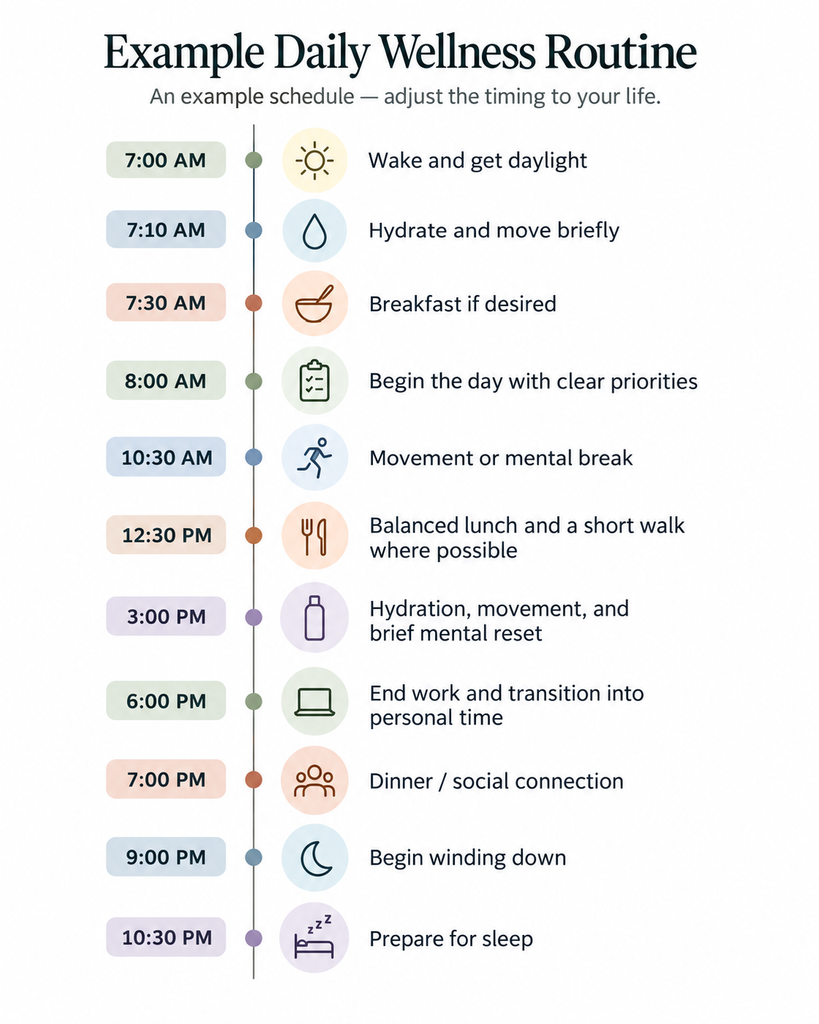
This is an example schedule. Adjust the timing to your life.
7:00 a.m. — Wake and get daylight
7:10 a.m. — Drink something and move briefly
7:30 a.m. — Breakfast if desired
8:00 a.m. — Choose your priorities
10:30 a.m. — Stand, walk or take a mental break
12:30 p.m. — Balanced lunch and a short walk if practical
3:00 p.m. — Hydration, movement and mental reset
6:00 p.m. — End work and transition into personal time
7:00 p.m. — Dinner and/or social connection
9:00 p.m. — Begin reducing stimulation
10:30 p.m. — Prepare for sleep
These times are not medically optimal times. A shift worker, student, parent, caregiver, freelancer or person managing a medical condition may need a completely different timetable.
Short on Time? Try This 5-Minute Wellness Reset
On a difficult day, try:
Minute 1: Pause and take several comfortable, slower breaths.
Minute 2: Drink something if you are thirsty.
Minute 3: Stand, stretch or move.
Minute 4: Step outside, look into the distance or move away from your screen.
Minute 5: Decide what you need next: food, movement, work, rest or connection.
Five minutes is not a treatment and it will not produce dramatic medical results.
Its value is simpler: it keeps the habit of checking in with your wellbeing alive.
Build a Wellness Routine That Fits Your Schedule
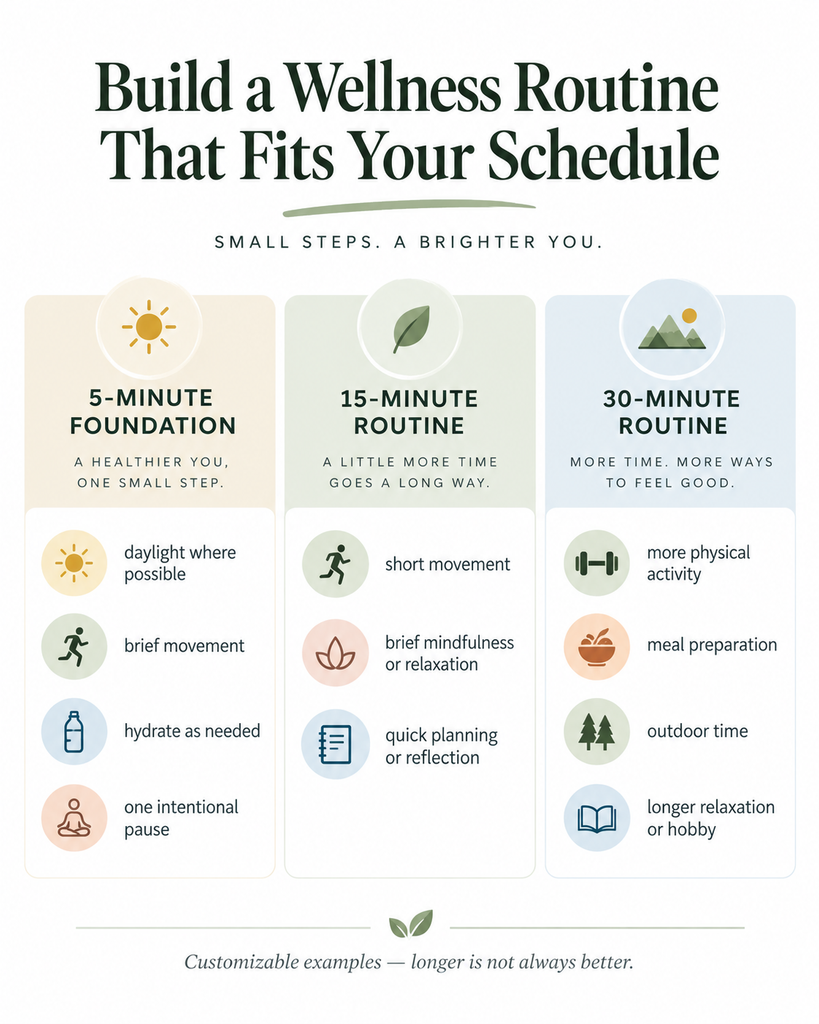
5-Minute Foundation
Choose only:
- light/daylight where possible
- brief movement
- hydration as needed
- one intentional pause
15-Minute Routine
Add:
- several minutes of movement
- a brief breathing or relaxation practice
- a quick plan or reflection
30-Minute Routine
Depending on your needs, add:
- longer physical activity
- meal preparation
- outdoor time
- reading
- a hobby
- longer relaxation
Thirty minutes is not automatically “better” than five.
A five-minute routine you maintain can be more useful than an elaborate routine that repeatedly collapses.
How to Build a Daily Wellness Routine You’ll Actually Keep
Start With Two or Three Habits
Do not try to implement this entire article tomorrow.
Choose the habits that solve your biggest current friction point.
For example:
- consistent wake time
- lunchtime walk
- calmer bedtime
Once those feel normal, decide whether adding another habit would genuinely help.
Attach Habits to Existing Routines
Existing activities can act as cues for new behaviours.
For example:
After I make my morning coffee, I will step outside for a few minutes.
Research on habit formation supports repeated behaviour in association with stable contextual cues, but no cue guarantees that a behaviour will become effortless.
Make Healthy Choices Easier
Adjust your environment instead of relying entirely on motivation.
Try:
- walking shoes near the door
- a reusable bottle where you can see it
- easy-to-assemble foods available
- unnecessary notifications switched off
- a book beside your bed
- work equipment put away after work
Making the desired action easier is often more practical than asking yourself to “try harder.”
Make the Routine Flexible
Create three versions:
Full version: what you do on a normal day.
Short version: what you do when time is limited.
Minimum version: what you can still manage on a difficult day.
This gives your routine somewhere to go when life becomes unpredictable.
Use a Minimum Version
If your usual plan is a 30-minute walk but today you only have a short window, take a shorter walk.
Scaling down is different from giving up.
Review What Is Actually Helping
Every few weeks, ask:
- Which habits make my day easier?
- Which ones do I constantly avoid?
- Which habits exist only because social media tells me they should?
- What could I simplify?
Remove habits that add unnecessary stress without giving you meaningful value.
Your Wellness Routine Doesn’t Need to Be Perfect
Wellness does not require:
- waking at 5 a.m.
- cold plunges
- green juice
- a complicated skincare routine
- a gym membership
- meditation every morning
- expensive supplements
- an immaculate diet
- tracking every step or calorie
- completing every habit every day
You are building a supportive structure, not performing a perfect lifestyle.
A useful routine leaves room for work, relationships, enjoyment and ordinary unpredictability.
And if persistent problems with sleep, mood, anxiety, appetite, energy or other aspects of your health are interfering with everyday life, discuss them with an appropriate healthcare professional instead of expecting a wellness routine to serve as treatment. NIMH similarly recommends seeking professional help for severe or distressing symptoms that persist.
Example Morning-to-Night Schedule
Use this as a standalone infographic/module:
| Example Time | Action |
|---|---|
| 7:00 AM | Wake + daylight |
| 7:10 AM | Hydrate as needed + brief movement |
| 7:30 AM | Balanced breakfast if desired |
| 8:00 AM | Pick 1–3 priorities |
| 10:30 AM | Movement/mental break |
| 12:30 PM | Balanced lunch + optional walk |
| 3:00 PM | Water + movement + mental reset |
| 6:00 PM | End work |
| 7:00 PM | Dinner/social time |
| 9:00 PM | Lower stimulation |
| 10:30 PM | Bedtime preparation |
Place directly underneath it:
“Example only — adjust these times to your work, sleep, family and health needs.”
Minimum-Viable Wellness Routine
For especially busy days:
Morning: daylight + drink according to thirst.
Daytime: eat, take one movement break and check in with your stress level.
Evening: create some boundary around work and give yourself enough opportunity to sleep.
And when even that feels unrealistic:
5-Minute Reset
1 minute breathe → 1 minute hydrate if needed → 1 minute move → 1 minute away from the screen → 1 minute decide what you need next.
This is one of the article’s best original-value sections. Keep it.
FAQs:
What is a good daily wellness routine?
A good routine supports sleep, movement, nutrition, hydration, mental recovery, relationships and stress management without becoming overwhelming. Start with a small number of habits that fit your schedule.
What should I include in a wellness routine?
Prioritize foundational behaviours such as sufficient sleep, physical activity, balanced meals, fluids, mental breaks and social connection. Optional practices such as meditation, journaling or yoga can be added if you genuinely find them useful.
How do I start a daily wellness routine?
Choose two or three small behaviours and connect them to parts of your day that already happen consistently. Once those behaviours feel manageable, decide whether another habit would add value.
How long should a wellness routine take?
There is no required duration. Wellness habits can be distributed throughout your day rather than completed in one session. Five minutes may be enough for a useful reset, while exercise, cooking or hobbies may naturally require longer.
What is a good morning wellness routine?
Wake at a reasonably consistent time, get some daylight, hydrate according to your needs, move a little, eat if you are hungry and decide what matters most that day.
What should I do for wellness at night?
Create a boundary around work, choose a calmer activity, reduce unnecessary stimulation and give yourself enough opportunity for sleep.
Do I need to follow the same wellness routine every day?
No. Consistency is useful, but a sustainable routine should adapt to weekends, travel, illness, family responsibilities and unexpected changes.
How many healthy habits should I start at once?
Two or three is a sensible practical starting point. There is no medically required number. Starting small lets you see what actually fits your life before adding more.