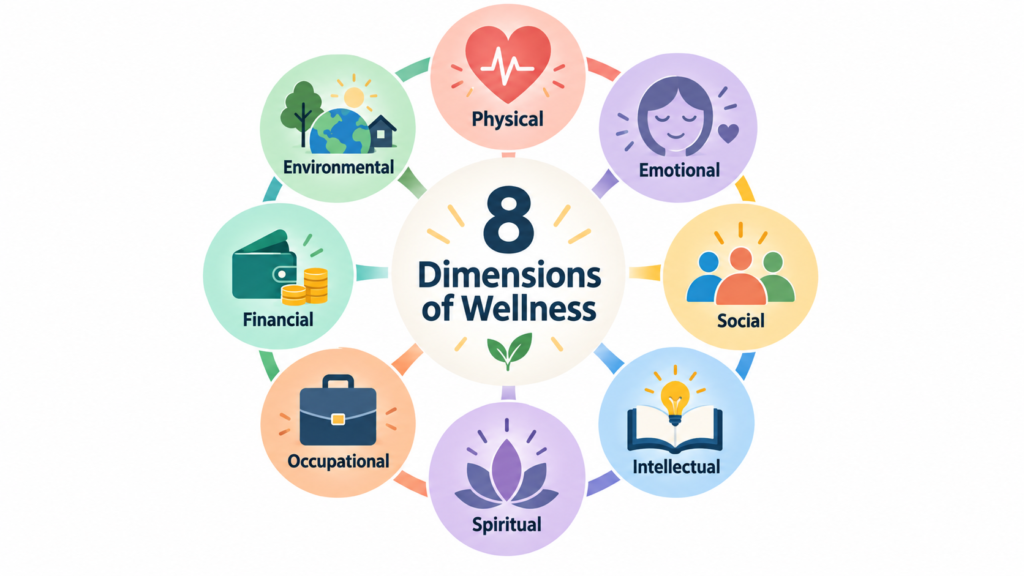
Wellness is often discussed as if it were mainly about exercise, nutrition or stress management. A broader approach recognizes that well-being can also involve relationships, work, finances, surroundings, learning, meaning and other parts of everyday life.
A widely used model describes eight dimensions of wellness: physical, emotional, social, intellectual, spiritual, occupational, financial and environmental wellness. SAMHSA has promoted this eight-dimension approach in behavioral-health wellness resources adapted from Margaret Swarbrick’s work.
Eight is not the only wellness framework, however. Different organizations divide wellness into different numbers and categories, so the model is better understood as a practical framework for reflection than as a universal medical classification.
What Is Wellness?
Wellness is broader than simply asking whether someone currently has an illness.
It can describe an ongoing process of considering the conditions, activities, relationships and choices that contribute to a person’s overall quality of life.
The National Wellness Institute, for example, describes wellness as multidimensional and as an evolving process rather than a single health outcome.
Individual choices matter, but they are only part of the picture. Income, housing, work conditions, access to health care, community resources and the environments where people live can also influence health and well-being. Healthy People 2030 explicitly identifies economic stability, health-care access, neighborhood conditions and social context among important determinants.
For a deeper look at the concept itself, see What Is Wellness? Definition, Meaning, and Examples.
Why Do Some Sources List Different Numbers of Wellness Dimensions?
You might encounter six dimensions on one website, eight on another and nine or ten somewhere else.
That does not necessarily mean one source is mistaken.
Wellness does not have a single universally standardized category system.
The National Wellness Institute uses Bill Hettler’s six-dimensional framework. SAMHSA wellness materials promote an eight-dimensional framework adapted from Swarbrick’s work. Binghamton University’s current nine-dimension model separately includes digital wellness, while ETSU’s ten-dimension model separately identifies digital and cultural wellness.
Other approaches may divide or combine categories differently.
For clarity, this guide uses the eight-dimension framework that includes physical, emotional, social, intellectual, spiritual, occupational, financial and environmental wellness.
What Are the 8 Dimensions of Wellness?
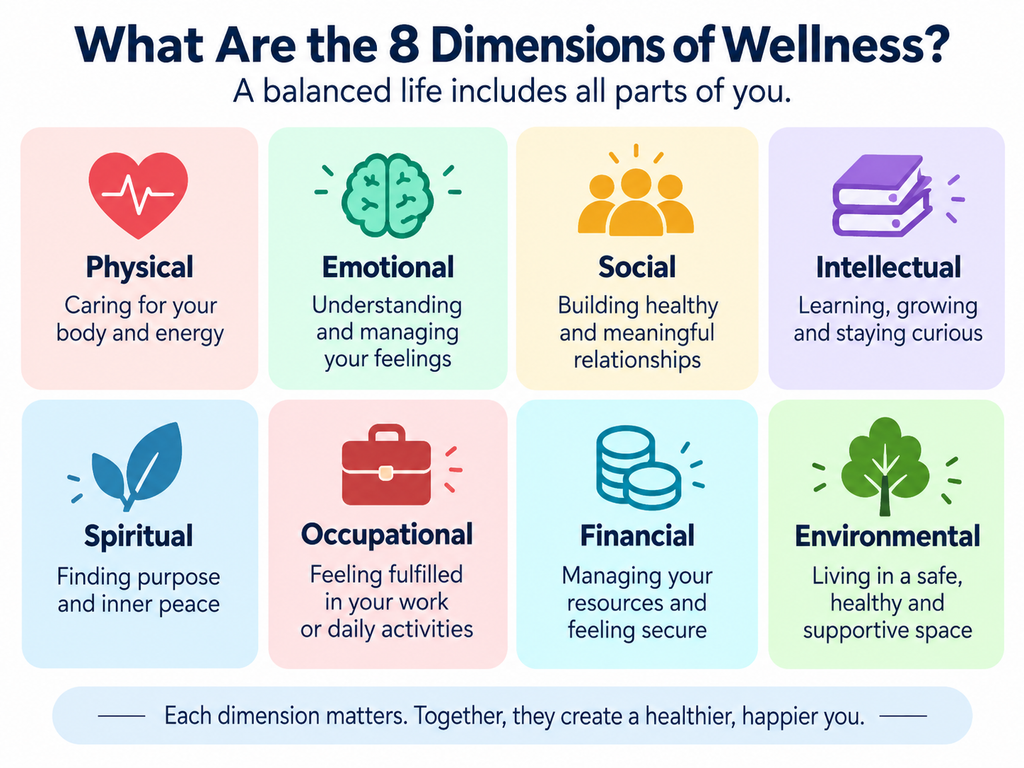
- Physical wellness: Supporting your body’s needs, health, safety and functioning.
- Emotional wellness: Understanding emotions and developing constructive ways to respond to challenges.
- Social wellness: Developing relationships, connection, boundaries and meaningful support.
- Intellectual wellness: Staying curious, learning and engaging your mind and creativity.
- Spiritual wellness: Exploring meaning, purpose, beliefs and personal values.
- Occupational wellness: Considering satisfaction, sustainability and meaning in work or other productive roles.
- Financial wellness: Understanding and managing financial circumstances and resources as realistically as possible.
- Environmental wellness: Considering how personal, community and natural surroundings affect daily life and well-being.
These areas overlap rather than functioning as eight isolated boxes.
1. Physical Wellness
Physical wellness concerns the everyday conditions and behaviors that support the body and appropriate health care.
It can involve sleep, physical activity, nutrition, safety, preventive care and obtaining medical attention when needed. SAMHSA’s eight-dimension framework includes physical wellness as one element of overall wellness, while public-health evidence also recognizes sleep and physical activity as important health-related behaviors.
Examples can include:
- Maintaining a workable sleep routine.
- Moving your body in ways appropriate to your ability.
- Meeting everyday food and hydration needs.
- Attending appropriate health appointments.
Physical wellness does not mean having a particular body shape or being free from every illness or disability. Someone living with a chronic health condition can still take actions that support physical wellness within their circumstances.
Learn more: Physical Wellness: Definition, Examples, and How to Improve It.
2. Emotional Wellness
Emotional wellness involves recognizing emotions, understanding how they affect you and developing ways to respond to life’s challenges.
It is not the same as feeling happy all the time.
Sadness, frustration, anger, fear and disappointment are normal human experiences. Emotional wellness is more concerned with awareness, coping, expression, support and the ability to adapt when circumstances change.
Examples might include talking with someone you trust, noticing patterns in your reactions, setting boundaries or seeking professional support when appropriate.
UC Davis similarly frames emotional wellness around awareness of feelings and responses to everyday interactions rather than constant positivity.
Learn more: Emotional Wellness: Definition, Examples, and How to Improve It.
Social wellness concerns the quality of your relationships, your sense of connection and your ability to give and receive appropriate support.
That does not mean collecting as many friends as possible.
Someone who prefers a small social circle may have excellent social wellness, while someone surrounded by people can still feel unsupported or disconnected.
Social wellness can include communication, belonging, trust, boundaries, family relationships, friendships and participation in communities that matter to you.
Examples include maintaining contact with a supportive person or communicating a boundary clearly.
UC Davis describes this dimension around meaningful relationships, supportive connections, communication and boundaries.
Learn more: Social Wellness: Definition, Examples, and How to Improve It.
4. Intellectual Wellness
Intellectual wellness refers to curiosity, learning, creativity, critical thinking and continued mental engagement.
It is not a measure of IQ, formal education or academic status.
People can support intellectual wellness through reading, hobbies, discussion, problem solving, artistic activities, professional learning or simply exploring subjects that interest them.
A person learning basic photography, studying another language or experimenting with a new recipe can be engaging this dimension without taking a formal course.
The central idea is continued engagement with ideas, skills and creativity.
Learn more: Intellectual Wellness: Definition, Examples, and How to Improve It.
5. Spiritual Wellness
Spiritual wellness concerns meaning, purpose, values and the beliefs or principles that help someone interpret life.
Religion can play an important role for some people, but religious practice is not required.
For one person spiritual wellness might involve prayer or participation in a faith community. For another it may involve meditation, time in nature, personal reflection, service, philosophy or trying to live consistently with deeply held values.
Binghamton University likewise describes spiritual wellness in terms of meaning and values while noting that it does not have to be aligned with religion.
Spiritual wellness should not be treated as a substitute for medical or mental-health care.
Learn more: Spiritual Wellness: Definition, Examples, and How to Improve It.
6. Occupational Wellness
Occupational wellness concerns the role that work and other meaningful productive activities play in life.
It can involve purpose, satisfaction, workplace conditions, skill development, boundaries and whether a role is sustainable within the rest of someone’s life.
It does not require everyone to “love their job.”
People may work primarily because they need income. Others may currently be unemployed, studying, caring for family members, volunteering or retired.
Workplace conditions and economic realities can also restrict how much control someone has over this area.
An occupational-wellness action could be asking for clearer role expectations, developing a useful skill or protecting time away from work where circumstances permit.
Learn more: Occupational Wellness: Definition, Examples, and How to Improve It.
7. Financial Wellness
Financial wellness involves understanding your financial circumstances and managing available resources, obligations and plans as realistically as possible.
It should not be confused with being wealthy.
Two people with the same budgeting skills may have completely different financial situations because income, housing costs, employment, debt, health-care expenses and family responsibilities differ.
Healthy People 2030 recognizes economic stability and access to resources as significant influences on health and quality of life.
Financial wellness might involve understanding where money is going, making a realistic spending plan, learning about debt obligations or seeking qualified assistance when a financial situation is difficult.
The purpose is informed management—not blaming people for circumstances outside their control.
Learn more: Financial Wellness: Definition, Examples, and How to Improve It.
8. Environmental Wellness
Environmental wellness includes the surroundings in which daily life takes place.
That includes more than recycling.
Your home, workplace, neighborhood, air quality, safety, noise, access to outdoor spaces and broader natural environment may all matter.
Healthy People 2030 recognizes neighborhood and built-environment conditions—including housing quality and environmental conditions—as relevant to health and quality of life.
Personal examples might include making a home workspace safer and more functional or reducing an avoidable household hazard.
At a broader level, environmental wellness can involve supporting cleaner community spaces or making sustainable choices when they are realistic and accessible.
Learn more: Environmental Wellness: Definition, Examples, and How to Improve It.
How the Dimensions of Wellness Affect One Another
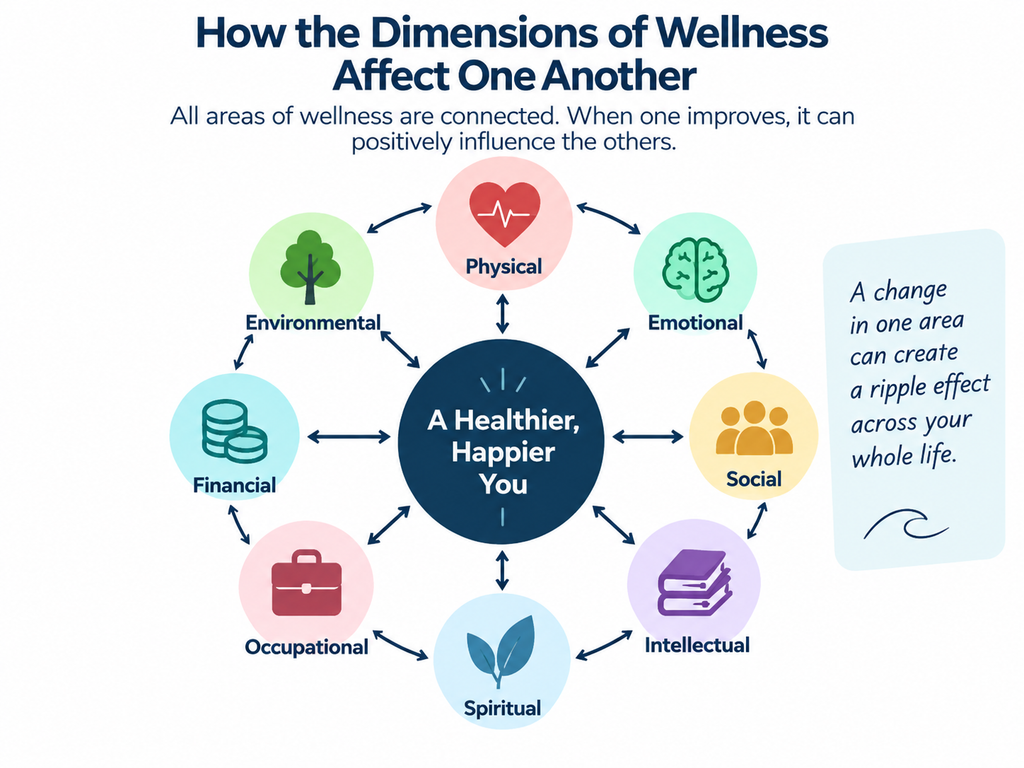
The greatest value of a multidimensional model may be seeing connections that are easy to miss when each area is considered separately.
Consider a few possibilities:
Financial → Emotional: uncertainty about bills may add emotional strain.
Occupational → Physical: long or irregular working hours can make sleep, meals and physical activity harder to manage.
Social → Emotional: supportive relationships may provide practical or emotional help during difficult periods.
Environmental → Physical: unsafe housing or limited access to usable outdoor spaces may constrain healthy options.
Physical → Occupational or Intellectual: illness, fatigue or pain may make concentration, studying or work more difficult.
These relationships are contextual rather than automatic cause-and-effect rules.
A wellness framework encourages you to ask, “What else might be connected to this problem?” rather than assuming one habit will solve every difficulty.
Do All 8 Dimensions Need to Be in Perfect Balance?
No.
Your priorities can change with your stage of life, health, employment, finances, relationships and responsibilities.
Someone caring for a new baby may temporarily have different priorities than someone entering retirement. A person dealing with a housing crisis may naturally focus on financial and environmental concerns before investing energy elsewhere.
UC Davis also explicitly states that perfect balance among the dimensions is not required.
A useful wellness framework helps identify needs. It should not create another standard of perfection.
What Is a Wellness Wheel?
A wellness wheel is a visual representation of multiple dimensions of wellness, usually arranged around a central point.
It can help you reflect on which areas currently feel supportive, strained or in need of attention.
It should not be treated like a medical diagnostic tool, and a low personal rating in one section does not diagnose a condition.
Different wellness wheels may also contain different numbers or categories because they are based on different wellness models.
For a detailed approach to interpreting one, see Wellness Wheel: What It Is and How to Use It.
A Simple Wellness Dimensions Self-Check
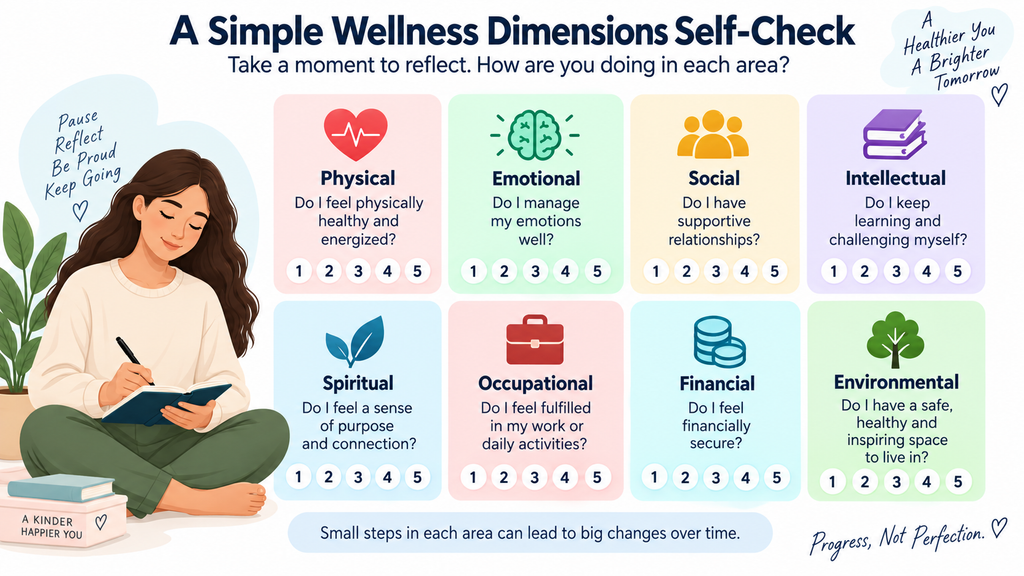
You can use the eight dimensions as reflection prompts:
Physical: Are my basic needs for sleep, food, movement, safety and health care reasonably supported?
Emotional: Do I have ways to recognize and cope with difficult emotions?
Social: Do I have relationships or communities in which I feel supported?
Intellectual: Do I have opportunities to learn, create or stay mentally engaged?
Spiritual: Do my choices connect reasonably well with my values or sense of meaning?
Occupational: Does my current work, study or other productive role feel sustainable enough?
Financial: Do I understand my current financial situation and know where I could seek help if needed?
Environmental: Do my surroundings generally support my safety and day-to-day needs?
This is a reflection exercise, not a diagnostic assessment.
How to Support Your Overall Wellness
Rather than trying to redesign every area of your life simultaneously, use a simple process:
- Review the eight dimensions.
- Notice one area that currently needs attention.
- Identify one realistic action within your control.
- Consider whether another dimension is contributing to the issue.
- Reassess as circumstances change.
Progress is usually more useful than trying to force perfect balance.
An Example of Wellness Dimensions Working Together
Imagine someone who has become consistently exhausted because of an intense work period.
A single-dimension view might conclude:
“I need a better sleep routine.”
A multidimensional view may reveal more.
Occupational wellness: working hours have become unusually long.
Financial wellness: reducing those hours may currently feel financially impossible.
Physical wellness: sleep has decreased.
Social wellness: the schedule leaves less time with supportive people.
The important lesson is not that one dimension “caused” the others.
It is that a wellness challenge may involve several overlapping parts of life. Improving only one habit may not address the entire situation.
Is Wellness the Same as Health?
The concepts overlap, but they are not always used identically.
WHO’s constitution famously defines health broadly in terms of physical, mental and social well-being rather than merely the absence of disease.
“Wellness,” meanwhile, is frequently used in multidimensional frameworks to describe an ongoing process involving habits, circumstances, meaning, relationships, environment and other aspects of life.
Neither term has only one universally accepted formulation.
For a dedicated terminology comparison, see Health vs Wellness vs Well-Being: What’s the Difference?
Dimensions of Wellness vs Components of Health
“Dimensions of wellness” and “components of health” should not automatically be treated as two names for the same framework.
The eight dimensions discussed here are one approach to understanding wellness.
A separate investigation of components of health may focus on physical, mental and social health or other categories depending on the framework being examined.
That query deserves independent research rather than forcing it to match the eight-dimensional wellness model.
Continue with Components of Health: Understanding the Main Areas of Health.
17. Wellness Dimensions Self-Check
For a reusable article box:
| Dimension | Reflection Question |
|---|---|
| Physical | Are my basic needs for sleep, food, movement, safety and appropriate health care reasonably supported? |
| Emotional | Do I have ways to understand and cope with difficult emotions? |
| Social | Do I have people or communities where I can find meaningful support? |
| Intellectual | Do I have opportunities to learn, create or stay mentally engaged? |
| Spiritual | Do my activities connect with my values, meaning or beliefs? |
| Occupational | Does my work, study or other productive role feel reasonably sustainable? |
| Financial | Do I understand my current financial situation and know where to seek appropriate help? |
| Environmental | Do my surroundings generally support my safety and everyday needs? |
Editorial note: Add directly below the table:
This self-check is a reflection tool, not a clinical or diagnostic assessment.
18. FAQs
What are the 8 dimensions of wellness?
A widely used eight-dimension framework includes physical, emotional, social, intellectual, spiritual, occupational, financial and environmental wellness. SAMHSA has promoted this model in resources adapted from Margaret Swarbrick’s wellness work.
Why are there different numbers of wellness dimensions?
Because wellness does not have one universally standardized taxonomy. The National Wellness Institute uses six dimensions, while other institutions use eight, nine or ten and may separately recognize areas such as digital, cultural or creative wellness.
Which dimension of wellness is most important?
There is no universally most important dimension within this framework. Needs change with health, safety, work, finances, relationships and life circumstances. An urgent need may temporarily deserve greater attention than other areas.
Do all eight dimensions need to be balanced equally?
No. The wellness wheel is more useful as a reflection framework than as a requirement for equal performance across every dimension. UC Davis likewise notes that perfect balance is unnecessary.
What is a wellness wheel?
A wellness wheel visually organizes several wellness dimensions so people can reflect on different areas of life. It can support self-reflection but should not be treated as a medical diagnostic tool.
Who created the eight dimensions of wellness?
The modern eight-dimension model is closely associated with Margaret Swarbrick’s wellness work. Her 2006 A Wellness Approach article is indexed by PubMed, and later SAMHSA materials explicitly adapted and promoted the model. A 2025 publication co-authored by Swarbrick also describes the model’s later adoption by SAMHSA.
Is financial wellness really a dimension of wellness?
It is included in the eight-dimensional framework promoted by SAMHSA, although not every wellness model uses the same categories. Financial circumstances can also overlap with broader determinants such as income, housing and access to essential resources.
Is wellness the same as health?
They overlap, but the terms are not always used interchangeably. WHO defines health broadly across physical, mental and social well-being, whereas wellness frameworks commonly emphasize an ongoing multidimensional process.