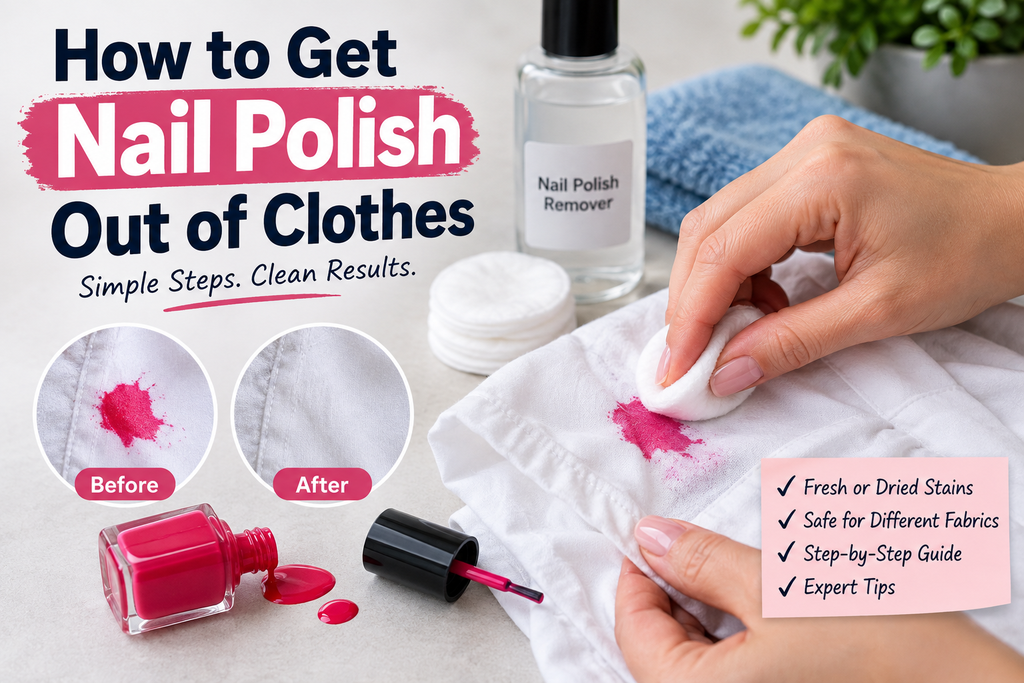
A nail-polish spill needs a different approach from an ordinary food stain. Before reaching for acetone or nail-polish remover, check the garment’s fiber content and care label. Some solvents that dissolve polish can also remove dye, damage finishes or harm the fabric itself.
For an ordinary washable garment with a solvent-compatible fiber, gently remove excess polish, place the stain against clean white absorbent material, patch-test your chosen remover, and dab rather than scrub so the dissolved polish transfers out of the fabric. Treat remaining residue with laundry detergent and follow the garment’s washing instructions.
Important: Do not use acetone as a universal solution. Textile guidance specifically warns against ordinary nail-polish-remover treatment on acetate, triacetate and modacrylic.
Before You Use Nail Polish Remover, Check the Fabric
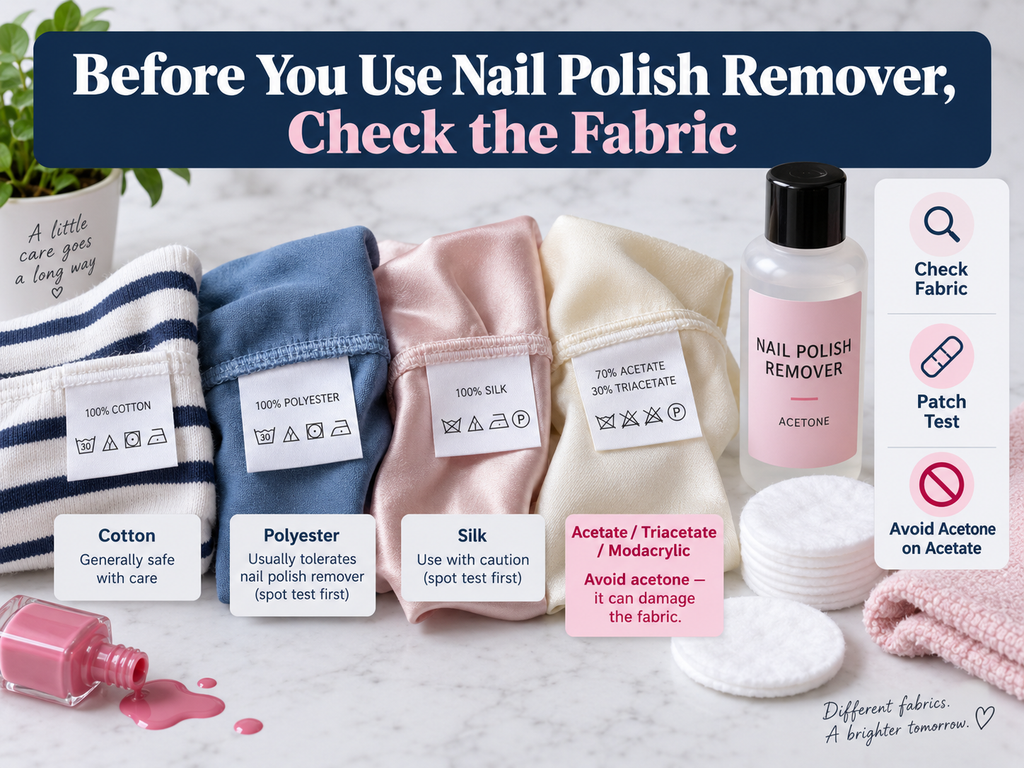
The first question isn’t whether the shirt is white or colored. It is what the shirt is made from.
Check:
- fiber-content label;
- care instructions;
- whether the garment is blended;
- trims, lining, prints or special finishes;
- colorfastness.
A white acetate dress can still be damaged by acetone. A dark cotton shirt may tolerate the fiber chemistry yet lose dye during treatment.
The care label matters because its instructions are intended to reflect treatments the garment can withstand as a complete item, including components such as trims and linings.
Why Nail Polish Is Hard to Remove From Fabric
Conventional nail polish is designed to dry into a durable coating rather than behave like a water-soluble stain. Once the liquid carriers evaporate, the remaining film can hold pigment and other ingredients around and between textile fibers.
That is why ordinary detergent may help clean the remaining residue but may not efficiently remove a hardened polish film by itself.
The practical issue is therefore not simply “What dissolves nail polish?” It is “What dissolves the nail polish without damaging this garment?”
Fresh vs Dried Nail Polish: Does the Method Change?
Yes.
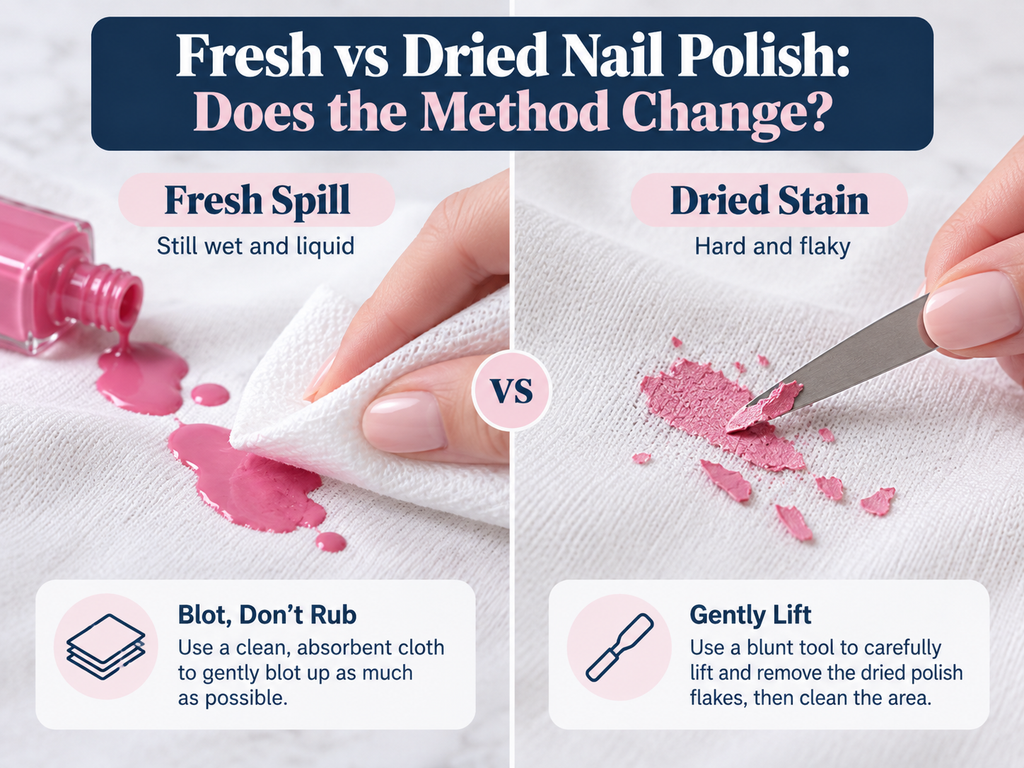
For a fresh spill, avoid wiping the liquid across a larger area. Use the edge of a spoon, plastic card or other blunt object to lift pooled polish where possible. Blot only when necessary; do not rub.
If the polish has become tacky and smears whenever touched, allowing it to firm slightly can make the excess easier to lift.
For dried polish, gently remove only flakes that release easily. Aggressive scraping can pull yarns, create fuzz or damage the fabric surface.
How to Get Nail Polish Out of Clothes Step by Step
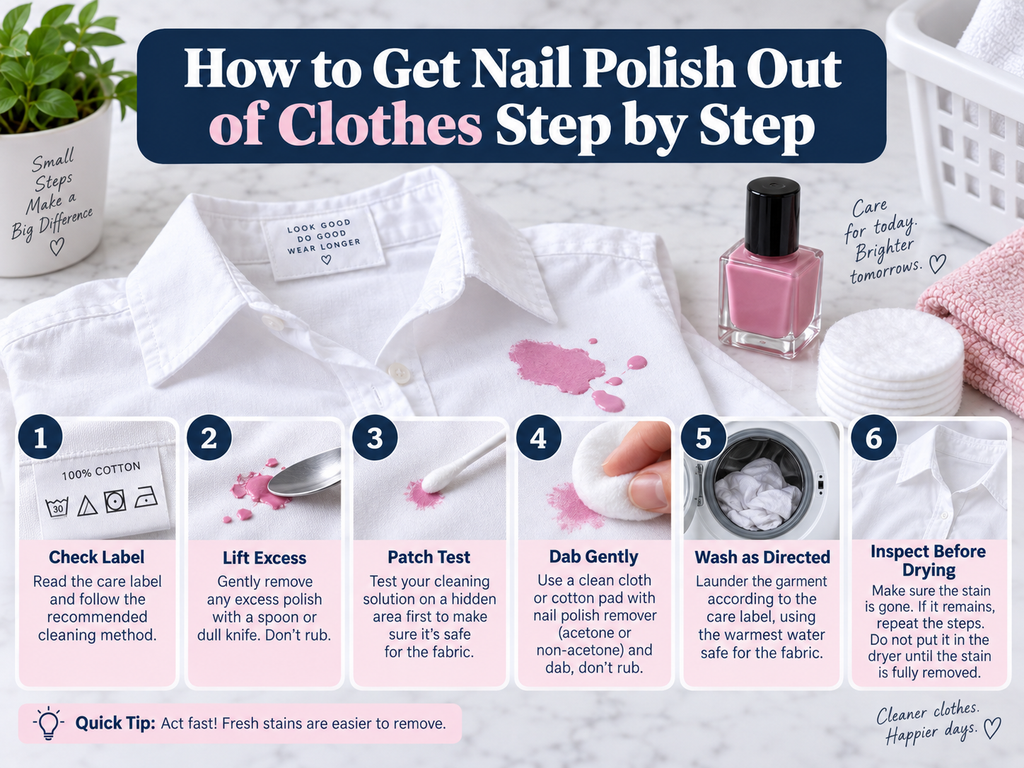
1. Read the care and fiber labels
Do not proceed with a solvent that conflicts with the garment’s instructions.
2. Remove excess polish
Use a spoon edge, blunt knife or plastic card. Never use a sharp blade.
3. Protect the surface underneath
Use clean white paper towels or an absorbent white cloth. White material makes it easier to see nail-polish transfer and garment-dye transfer.
4. Patch-test the remover
Apply a tiny amount to a hidden seam or hem.
Stop if you notice:
- garment dye on the cloth;
- texture changes;
- distortion;
- fading;
- surface damage.
UGA recommends testing cleaning agents on an inconspicuous area before stain treatment.
5. Transfer rather than scrub
For a compatible washable garment, one useful arrangement is to position the stained area face-down against clean absorbent material and work carefully from the reverse.
The purpose isn’t simply to “clean from the back.” The purpose is to move dissolved polish out of the garment and into the absorbent pad.
Replace the pad as it becomes stained. UGA describes the same basic face-down/back-side transfer principle.
6. Treat the remaining residue
Once the polish coating has been removed as far as safely possible, use an appropriate liquid laundry detergent on washable garments.
Detergent helps remove residual soils and product ingredients; it does not “neutralize” acetone.
7. Follow the garment’s laundering instructions
Do not assume hotter is always better. Use the care-label instructions.
8. Inspect before heat drying
Do not use dryer heat while the stain is still present.
More importantly, never put a garment that is still wet with a flammable solvent into a washer or dryer. Appliance guidance warns against washing or drying articles containing flammable substances.
Follow the remover’s safety label and your appliance instructions before machine laundering a solvent-treated item.
Can You Use Acetone to Remove Nail Polish From Clothes?
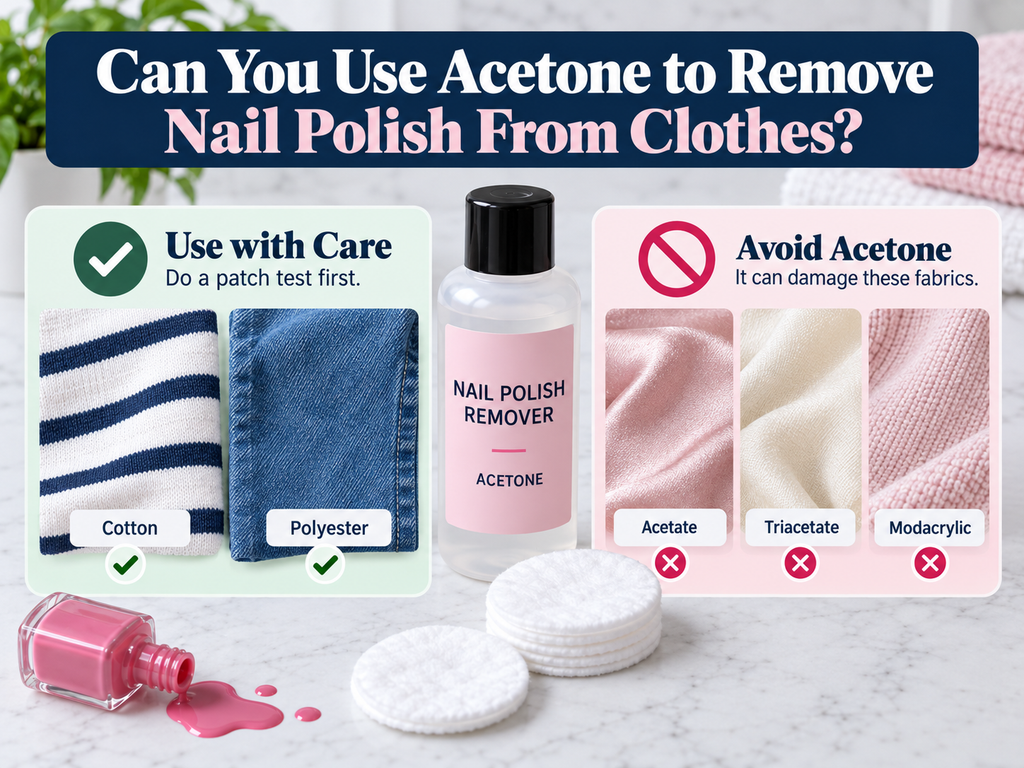
Sometimes—but not on every garment.
Acetone is an effective solvent, but it can remove garment dye and damage incompatible textile materials. Tide and UGA both specifically warn against its use on certain fibers.
Do not use acetone on acetate fabric
This deserves more than a generic “may fade” warning. Acetone can seriously damage acetate material itself.
Triacetate and modacrylic should also be treated as exclusions for ordinary nail-polish-remover DIY treatment.
A successful hidden-area test also does not override a care label that prohibits the treatment.
Is Non-Acetone Nail Polish Remover Safer for Clothes?
Not automatically.
“Acetone-free” only tells you what the product does not contain. It does not mean:
- fabric-safe;
- dye-safe;
- suitable for every synthetic fiber;
- nonflammable.
For example, one current OPI acetone-free formulation lists ethyl acetate, ethyl lactate and other ingredients.
A safety data sheet for another acetone-free remover lists more than 60% ethyl acetate and more than 30% ethanol and classifies the product as flammable.
Read the remover’s own ingredient and safety information rather than assuming all non-acetone products behave alike.
How to Get Nail Polish Out of Cotton Clothes
Cotton is generally less vulnerable to acetone itself than acetate, but that doesn’t make every cotton garment solvent-proof.
A cotton garment can still have:
- unstable dye;
- a printed design;
- special finishes;
- synthetic lining;
- blended fibers.
Check the complete composition, patch-test, then use only a compatible treatment in small amounts.
How to Get Nail Polish Out of Jeans
Denim should not be treated as indestructible.
Check whether the jeans are pure cotton or a stretch blend. Many jeans include elastane or other fibers, and dark indigo dye may transfer during solvent treatment.
Test a hidden seam first. If blue garment dye begins appearing on your white cloth, stop.
Tide likewise recommends a hidden-area test and a white absorbent backing for jeans.
How to Remove Nail Polish From Polyester
Do not translate “polyester” into “acetone-safe.”
Check the entire fiber blend, garment finish, print, lining and care label. UGA includes polyester among fibers on which certain nail-polish-removal solvents may be usable, but it also emphasizes pretesting and colorfastness.
Use the smallest amount necessary and stop at the first sign of damage.
How to Get Nail Polish Out of White Clothes
White fabric is not automatically safe for acetone.
A white garment can still contain acetate, elastane, decorative stitching, printed areas or solvent-sensitive finishes.
Identify the material first.
Also avoid jumping directly from nail-polish remover to chlorine bleach. Different cleaning chemicals should not be casually combined.
How to Get Nail Polish Out of Colored Clothes
Colorfastness matters as much as stain removal.
Use a white cloth so you can see whether the garment’s own dye is transferring.
If the nail-polish stain is fading but the garment color is disappearing with it, stop. A cleaner stain is not a successful result if the treatment permanently discolors the clothing.
What About Silk, Wool, Cashmere or Delicate Clothes?
For valuable silk, wool, cashmere, beaded garments, wedding clothes, vintage pieces or structured formalwear, aggressive DIY solvent treatment usually creates more risk than benefit.
Lift obvious excess gently without rubbing and take the item to a professional cleaner.
Tell the cleaner the stain is nail polish so the treatment can be chosen accordingly.
Nail Polish on Dry-Clean-Only Clothes
Do not soak, machine wash or experiment with strong solvents.
Care-label warnings exist for a reason, and dry-clean-only garments may contain dyes, finishes, adhesives, interlinings or construction details that react poorly to home treatment.
Remove only loose excess and seek professional cleaning.
Can You Remove Nail Polish From Clothes Without Nail Polish Remover?
Sometimes.
If the spill is tiny and much of it can be physically lifted before it cures, detergent and normal laundering may remove what remains.
But a fully dried lacquer film may require an appropriate solvent. The responsible alternative to nail-polish remover is not necessarily vinegar, toothpaste or another internet hack—it may simply be a professional cleaner.
Does Hairspray Remove Nail Polish From Clothes?
Older stain-removal advice often recommends alcohol-rich hairspray, and Persil’s UK page still suggests an alcohol-based hairspray option for acetate.
That is not a good universal recommendation.
Modern hairsprays vary in alcohol, oils, fragrances, conditioning ingredients and polymers. More importantly, textile guidance says alcohol can fade dyes and damage acetate, triacetate, modacrylic and acrylic fibers.
Use a textile-appropriate stain method instead.
What About Gel or Glitter Nail Polish?
Glitter polish may leave physical particles after the main coating is removed. Lift those gently rather than scrubbing them deeper into the weave.
Gel polish is harder to generalize. Textile-specific authoritative evidence is considerably thinner than it is for ordinary lacquer, particularly once gel has cured. Avoid inventing a special DIY solvent recipe. If cured gel is attached to an expensive garment, professional treatment is the safer option.
Safety Warning: Nail-Polish Removers Can Be Flammable
Acetone is highly flammable, and acetone-free formulations may also contain flammable solvents such as ethyl acetate and alcohol.
Work with good ventilation and keep solvent away from:
- cigarettes;
- candles;
- fireplaces;
- gas burners;
- space heaters;
- sparks;
- high heat.
Do not deliberately inhale vapors.
Mistakes to Avoid When Removing Nail Polish From Clothes
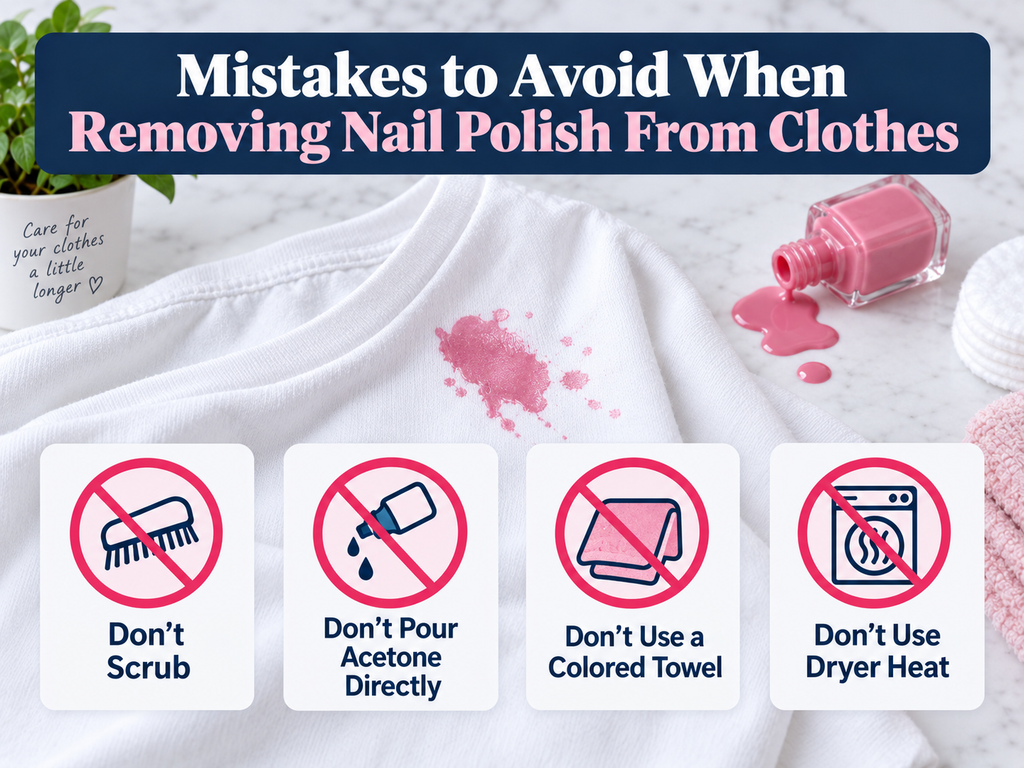
Avoid rubbing fresh polish, pouring acetone directly over an unidentified garment, assuming “white” means safe, using colored towels, aggressively scraping dried polish, saturating lined garments, continuing after garment dye starts transferring, mixing multiple cleaners, using open flame around solvents, or exposing a solvent-wet garment to dryer heat.
The goal is not to remove the stain at any cost. If removing it is likely to destroy the textile, preserving the garment takes priority.
FAQs:
Does nail polish come out of clothes?
Sometimes. Fresh stains and compatible washable fabrics often give you a better chance, but old or heavily absorbed stains may not disappear completely.
Does acetone ruin clothes?
It can. Acetone may strip dye, damage finishes and severely damage incompatible fibers such as acetate.
Does nail polish remover stain clothes?
It can cause discoloration or leave additional residue depending on its solvents, dyes, oils or other ingredients. Patch-test the actual product first.
Can you use acetone on cotton?
Potentially, provided the care label permits treatment and the garment’s dye, finish, print and any blended fibers pass a hidden-area test.
Can you use acetone on polyester?
Do not assume yes automatically. Check the complete garment composition and patch-test first.
How do you remove dried nail polish?
Lift loose hardened material with a blunt edge, test a compatible solvent, then transfer the softened polish into clean white absorbent material instead of scrubbing.
How do you remove nail polish without acetone?
A compatible non-acetone product or professional cleaning may be appropriate. “Acetone-free” still requires label checking and patch testing.
Does rubbing alcohol remove nail polish from clothes?
It can act as a solvent in some situations, but it is not universally safe. UGA notes that alcohol can fade dyes and damage several synthetic fibers.
Does hairspray remove nail polish?
Some old cleaning advice relies on alcohol-heavy hairspray, but modern formulations vary and it is not a preferred universal treatment.
Does vinegar remove nail polish?
Vinegar should not be treated as a substitute for a compatible nail-polish solvent.
Can dried nail-polish stains become permanent?
Yes. Sometimes the film becomes difficult to remove without causing unacceptable garment damage. Clorox’s current guidance is notably conservative about dried stains for this reason.
What fabrics should never be casually treated with acetone?
Acetate is the clearest prohibition; triacetate and modacrylic are also specifically excluded from standard nail-polish-remover treatment in textile-extension guidance.