
Useful wellness habits for busy people are not the habits that require the most equipment, tracking or free time. They are the ones that help you protect basic health needs while fitting around work, study, family, commuting, caregiving or an unpredictable schedule.
That usually means protecting sleep, adding movement in manageable chunks, keeping nutritious food convenient, drinking enough for your circumstances, taking short mental breaks, limiting unnecessary digital interruptions and staying connected with other people.
You do not need to implement all of those at once. Start with one or two areas that are currently creating the most friction.
Small habits can make healthy behavior easier to start. They do not replace adequate sleep, nutritious eating, recommended physical activity, medical care or mental-health care.
The Best Wellness Habits for Busy People Reduce Friction
A healthy behavior becomes much harder when it requires several extra steps.
If taking a walk requires driving somewhere first, you are more likely to skip it during a demanding week. Walking near home, work or campus may be easier.
If eating well requires cooking seven different dinners from scratch, a difficult evening can derail the whole plan. Keeping several reliable meals at home gives you another option.
If your exercise plan works only when you have 60 uninterrupted minutes, have a shorter fallback version.
If meditation requires finding another 20-minute block in your calendar, you might instead take a brief quiet pause after lunch or between meetings.
Reducing friction does not mean every worthwhile health behavior should feel effortless. Exercise, cooking, healthcare appointments and protecting sleep can still require deliberate choices. The goal is to remove unnecessary complexity.
If You’re Extremely Busy, Start With These Basics
When your schedule is packed, prioritize foundations before adding wellness extras.
A reasonable starting framework is:
- Create enough opportunity for sleep.
- Move regularly within your ability.
- Make adequate, reasonably balanced food easier to obtain.
- Keep fluids accessible.
- Preserve some mental or social recovery.
WHO includes adequate sleep, physical activity, healthy eating and social connection among important forms of self-care.
The precise order can change. Someone who is consistently sleeping too little may need to begin there. Someone whose work involves long periods of sitting may focus first on movement. Someone skipping meals because of caregiving may need food convenience first.
The purpose is prioritization, not another checklist.
Protect Sleep Before Adding More Wellness Tasks
Busy people sometimes create extra hours by taking them from sleep.
That is a poor trade if your new wellness routine means you are regularly getting less sleep than you need.
Current NHLBI guidance says adults generally need around 7 to 9 hours of sleep a night, although individual needs vary.
Start with the amount of time you need to be awake and work backward far enough to provide a reasonable sleep opportunity.
Helpful basics include:
- Keeping sleep and wake times reasonably consistent when your schedule allows
- Having a few simple cues that the workday is over
- Making the sleeping space reasonably dark, quiet and comfortable
- Moving caffeine earlier if late use interferes with your sleep
- Avoiding unnecessary late-night work when it can wait
NHLBI notes that caffeine can interfere with sleep for hours and recommends a reasonably consistent sleep schedule.
Most importantly:
Do not wake at 5 a.m. for a wellness routine if doing so means cutting needed sleep.
Morning exercise, journaling or meal preparation is not automatically healthier than sleeping.
Shift workers face additional challenges because work may conflict with normal sleep timing. NHLBI suggests protecting the available sleep period, controlling light and noise during daytime sleep and limiting caffeine to the earlier part of a shift where appropriate.
Use Short Movement Opportunities Instead of Waiting for the Perfect Workout

You do not need to wait until a full gym session fits your calendar before moving.
Useful options include:
- A 5- or 10-minute walk
- Walking during a phone call when safe
- Walking at lunch
- Taking stairs when appropriate for your ability
- A brief home workout
- Short strength sessions
- Walking with family
- Moving while children play
- Standing or changing position after long periods at a desk
- Active commuting where safe and realistic
The important distinction is between moving more and meeting recommended activity levels.
Short movement opportunities count toward activity and are worthwhile. They do not automatically mean that someone has met the broader physical-activity recommendation.
Current U.S. guidance recommends at least 150 minutes of moderate-intensity aerobic activity each week for adults, plus muscle-strengthening activity on two days. The aerobic activity can be divided across the week, and CDC emphasizes that any amount of physical activity has some benefit.
WHO similarly states that some activity is better than none and recommends gradually increasing activity where appropriate.
A Short Workout Still Counts
Five or 10 minutes of activity is still activity.
A short walk is not a failed 45-minute workout.
A 10-minute home strength session is not pointless because it was short.
Use the available session, then accumulate more activity across the week as your capacity allows.
| If You Have… | Try… |
|---|---|
| 1 minute | Stand, move or change position |
| 5 minutes | Short walk or mobility break |
| 10 minutes | Brisk walk or short activity session |
| 20 minutes | Walk, home workout or strength session |
| 30+ minutes | Longer exercise session if your schedule allows |
This is a menu, not a prescription.
Make Healthy Eating Easier Than Ordering From Scratch Every Time
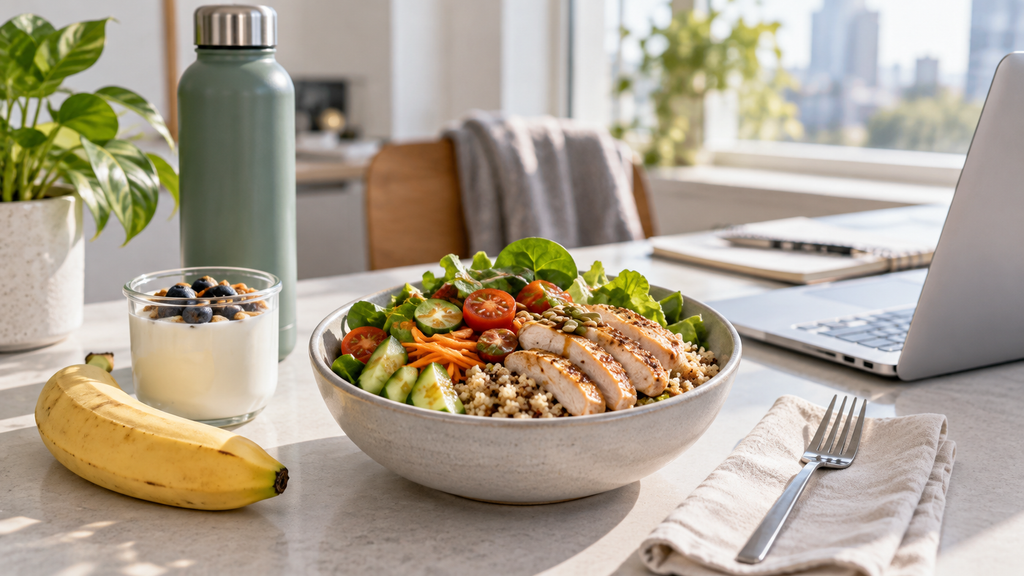
Healthy eating does not require cooking every ingredient yourself.
Frozen vegetables are still vegetables. WHO specifically notes that fresh, frozen and canned fruits and vegetables can all contribute to a healthy diet, with attention to added sugars or excessive sodium where relevant.
Convenient options can include:
- Frozen vegetables
- Canned beans or lentils
- Eggs
- Yogurt
- Fruit
- Whole-grain breads or other staple grains
- Pre-cooked or canned protein options
- Prepared vegetables
- Simple soups
- Leftovers
- Rotisserie chicken where culturally and practically appropriate
- Frozen meals that reasonably fit your needs
Convenience is not failure.
Use a Simple Meal Formula
Instead of building every meal around a recipe, choose components.
1. A protein source
Examples may include beans, lentils, eggs, yogurt, tofu, fish, poultry, meat or culturally familiar alternatives.
2. A carbohydrate or grain
Rice, bread, potatoes, oats, maize, pasta or another staple can fit here, with whole-grain choices where available and appropriate.
3. Vegetables or fruit
Fresh, frozen, canned or prepared options can work.
4. A source of fat where useful
For example, nuts, seeds, avocado, dairy or plant oils depending on the meal and local diet.
WHO emphasizes variety and diets containing foods such as vegetables, fruits, legumes, nuts and whole grains rather than prescribing one culturally narrow meal pattern.
Keep Backup Meals for Overloaded Days
An emergency meal is simply a meal you can assemble when the original plan collapses.
Examples:
- Eggs + bread + fruit
- Beans + rice + frozen vegetables
- Yogurt + oats + fruit + nuts or seeds
- Soup + bread + a protein side
- Leftover rice + vegetables + eggs or another protein
- Rotisserie chicken + prepared vegetables + a convenient grain
- Frozen vegetables + canned beans + a staple carbohydrate
- Leftovers from an earlier meal
Use foods that fit your culture, budget, dietary needs and access.
Let Go of Nutrition Guilt
Wellness does not require:
- Cooking everything from scratch
- Perfect macros
- Organic-only foods
- Eliminating all takeaway
- Avoiding every processed food
- Complicated recipes
- Following a no-carb rule
- “Detoxing”
Overall patterns matter more than making every individual meal ideal.
Make Hydration Convenient
Hydration does not need to become another tracking project.
Try:
- Keeping water accessible at your desk or work area
- Drinking with meals
- Bringing water on a commute
- Refilling your bottle when you already get up
- Drinking more when heat, illness or physical activity increases fluid losses
There is no single water amount that is ideal for everyone. Fluid needs vary with factors such as body size, activity, climate, pregnancy, illness and health conditions.
You do not need:
- A universal gallon target
- A rule that everyone must drink exactly eight glasses
- Electrolytes for every ordinary day
- Lemon water
- A hydration app if tracking it creates more work
People with medical conditions that affect fluid balance may need individualized instructions from a healthcare professional.
Attach Wellness Habits to Things You Already Do
Instead of adding another appointment, use existing activities as cues.
For example:
- After making coffee → step outside briefly
- After lunch → walk for a few minutes
- During a phone call → stand or walk where safe
- After brushing your teeth → prepare tomorrow’s essentials
- When closing your laptop → take a short transition walk
- While watching television → stretch or move if you want to
- When filling your plate → add an easy fruit or vegetable
- When leaving work → refill tomorrow’s water bottle
Habit pairing does not guarantee that a behavior will become automatic. It simply gives the behavior an existing cue.
Use Short Breaks Before You Feel Completely Drained
A break does not have to be long to interrupt continuous sitting, screen exposure or concentrated work.
A short break might mean:
- Standing
- Looking away from the screen
- Walking briefly
- Stretching
- Getting water
- Going outside
- Taking several slower breaths
- Speaking with someone
There is no need to describe these as a “brain reset” or “nervous-system reset.”
They are simply pauses.
Reduce Digital Tasks That Pretend to Be Urgent
Busy people often have a second workload running in the background: notifications.
Email alerts, chat messages, group conversations, news, social media, app reminders and wellness trackers can all compete for attention.
Experimental research has found that phone notifications can interfere with performance on attention-demanding tasks even when a person does not open the notification.
Consider:
- Turning off low-value notifications
- Using focus or do-not-disturb settings
- Batching nonurgent messages when your work permits it
- Removing work notifications during protected personal time
- Keeping work email away from the final minutes before sleep where possible
- Unfollowing or muting sources that add little value
- Removing health-tracking reminders you no longer use
This does not mean every notification is harmful or that every person needs fewer digital tools.
The better question is:
Does this information help me do something useful, or has receiving it become another task?
Social connection does not always need its own evening on the calendar.
You might:
- Walk with a friend
- Call family during a safe commute
- Eat with someone
- Exercise together
- Run errands together
- Send a short check-in message
- Talk with a colleague during a break
WHO’s Commission on Social Connection recognizes social connection as an important component of health and well-being.
That does not mean someone needs a large social network. People vary widely in how much interaction they prefer.
If you live alone, are introverted, have mobility limitations or have major caregiving responsibilities, smaller forms of contact may fit better than frequent social events.
Keep One Stress-Management Tool You Can Use Anywhere
You do not need a collection of five relaxation practices.
Choose one or two that are realistic for you.
Options include:
- Slower breathing
- A short walk
- Music
- Brief mindfulness
- Prayer
- Journaling
- Stretching
- Speaking with someone
- Quiet time
CDC recommends individualized healthy coping strategies and also suggests taking breaks from constant news and social media when those are increasing stress.
Avoid judging a technique by whether it “lowers cortisol.”
The practical question is whether it gives you a usable way to pause, recover or cope.

Wellness Habits That Take About a Minute
When only a small gap is available, you could:
- Stand and move
- Refill your water
- Open curtains or step into daylight
- Send someone a check-in message
- Add fruit to a meal
- Put tomorrow’s essential item near the door
- Take several slower breaths
- Silence one distracting notification
- Write down one task instead of continuing to hold it mentally
None of these needs to produce dramatic health effects to be useful.
Their value is convenience.
Wellness Habits You Can Do in 5 Minutes
Choose one:
- Take a short walk
- Do basic mobility
- Prepare a simple snack
- Sit outside
- Do a short relaxation exercise
- Message or call someone
- Clear a small functional area
- Prepare breakfast ingredients
- Set up your sleep environment
- Pack food or your work bag
Five minutes is a fallback option, not a requirement that everything health-related should take five minutes.
If You Have 10 to 15 Minutes
Use the time for the area you currently need most.
You might:
- Take a brisk walk
- Do a short strength session
- Prepare a simple meal
- Eat away from your desk
- Use a relaxation practice
- Shower and transition out of work
- Prepare a few ingredients for tomorrow
- Spend uninterrupted time with someone
Do one.
You are not supposed to complete the entire list before returning to work.
The Bare-Minimum Wellness Plan for an Overloaded Day
Some days have almost no flexible capacity.
On those days, a practical minimum may be:
- Eat enough to meet basic needs.
- Drink according to your needs.
- Take prescribed medications as directed.
- Move within your ability.
- Complete essential hygiene.
- Get at least some mental or social recovery if possible.
- Protect enough time for sleep.
A bare-minimum day is not a special health program. It is simply the scaled-down version you use when optional tasks need to disappear.
Micro-habits do not replace medical or mental-health treatment.
Scale Wellness to the Kind of Day You’re Having
| Type of Day | Appropriate Focus |
|---|---|
| Normal busy day | Short movement + simple meals + breaks + reasonable bedtime |
| Very overloaded day | Food + medication + hydration + hygiene + sleep |
| More flexible day | Longer exercise + cooking + social time + hobbies + preparation |
Capacity changes.
Your health strategy can change with it.
Use Small Boundaries Instead of Waiting for Perfect Work-Life Balance
Not everyone can control their working hours, workload or schedule.
A useful boundary therefore needs to fit your actual authority.
Possibilities include:
- Eating away from the screen occasionally
- Choosing a work stopping point when circumstances permit
- Silencing nonurgent work messages during protected time
- Avoiding work email immediately before sleep
- Protecting one small portion of the week from optional work
- Not answering every nonurgent message immediately
A nurse, shift worker, small-business owner, hourly worker and parent will not have identical options.
Advice that assumes complete control over your schedule is not realistic wellness advice.
Spend a Few Minutes Reducing Tomorrow’s Friction
Use preparation to make tomorrow easier, not to optimize every minute.
You might:
- Put walking shoes near the door
- Pack basic food
- Refill your water bottle
- Prepare clothes
- Put your bag and keys together
- Add an appointment reminder
- Prepare an easy breakfast
- Make sure medication-management supplies are safely ready according to your normal routine
Stop once tomorrow is easier.
There is no prize for turning nighttime into another planning session.
You Don’t Have to Track Everything
Health information can be useful.
Some people benefit from tracking:
- Steps
- Food
- Water
- Sleep
- Heart rate
- Workouts
- Habits
Other people find that detailed tracking creates another recurring task.
There is no universal requirement to measure all of these things.
Use tracking when it gives you information you intend to use.
Stop or simplify it when the data is no longer helping.
How to Adapt Wellness Habits to Your Schedule
Busy office workers
Keep movement close to work. Walk during lunch or between meetings, keep convenient food nearby and reduce unnecessary notification interruptions.
Commuters
Use the commute to simplify rather than add tasks. Carry water or food when useful, walk part of the journey where safe, or use public-transport time for quiet rather than more work.
Remote workers
Create deliberate transitions because commuting no longer provides them. A short walk before or after work can separate working time from personal time.
Parents and caregivers
Combine rather than multiply activities. Walk with family, prepare shared simple meals and use a reduced routine during intense caregiving periods.
Students
Protect sleep around deadlines where possible, keep backup meals available and use movement between classes rather than waiting for a perfect workout window.
Shift workers
Do not force wellness into conventional morning and evening schedules. Anchor behaviors to your own wake, work and sleep periods.
Freelancers and business owners
Create stopping cues because work has no natural closing time. Protect at least some periods where nonurgent business notifications are muted.
People with mobility limitations
Use movement appropriate to your ability and individualized recommendations. Wellness should not be defined by walking or step counts.
Know What Is Foundational and What Is Optional
| Wellness Habit | Priority | Time Required | Low-Friction Version |
|---|---|---|---|
| Sleep | Foundational | Hours | Protect sleep opportunity |
| Movement | Foundational | Variable | Short bouts throughout the day |
| Adequate balanced food | Foundational | Variable | Simple repeat meals |
| Hydration | Foundational | Minimal | Keep fluids accessible |
| Stress coping | Important | 1+ min | One usable coping tool |
| Social connection | Important | Variable | Message, call or walk together |
| Digital boundaries | Helpful | Seconds | Silence unnecessary alerts |
| Preventive health | Foundational over time | Variable | Schedule/refill when due |
| Enjoyable activity | Valuable | Variable | Small version when busy |
Cold plunges, expensive recovery equipment, elaborate supplement stacks, wellness powders, wearable data, long meditation sessions and complex skincare are optional.
They are not prerequisites for wellness.
What About Supplements?
A supplement routine is not a substitute for adequate food, sleep, movement or medical care.
Supplement needs can depend on diet, age, pregnancy, health conditions, medications and documented deficiencies.
That is different from saying every busy person needs magnesium, vitamin D, electrolytes, greens powder or an “energy” supplement.
Don’t Let Being Busy Postpone Necessary Healthcare Forever
Being busy does not make preventive or ongoing healthcare optional.
That may include:
- Medical appointments
- Dental care
- Prescription refills
- Vaccinations according to local recommendations
- Recommended screening
- Follow-up for known conditions
Preventive recommendations vary according to age, location, medical history and other factors, so this article should not provide one generic screening calendar.
U.S. HHS describes preventive care as including appropriate checkups, screening tests and vaccines and emphasizes individualized recommendations.
If physical or psychological symptoms are persistent, severe, concerning or significantly disrupting daily life, a micro-habit list is not an adequate substitute for professional evaluation.
Start Smaller Than Your Ambition
You do not need a better morning routine, evening routine, workout plan, meal-prep system, meditation schedule, water tracker and sleep app by Monday.
Choose one or two pressure points.
Make the useful behavior easier.
Keep the bigger health foundations in view.
Then expand only when your schedule and capacity allow.
18. If You’re Extremely Busy, Start Here
For the most condensed editorial callout:
Start with five areas:
- Protect enough opportunity for sleep.
- Move whenever realistic and accumulate more activity over time.
- Keep adequate, reasonably balanced food easy to access.
- Keep fluids available.
- Preserve at least a little mental or social recovery.
Do not start with supplements, wearables or elaborate routines.
19. One-Minute Wellness Habits
Use these as a scannable box:
- Stand or change position
- Refill water
- Step into daylight
- Silence a low-value notification
- Add fruit or vegetables to an existing meal
- Send a check-in message
- Put tomorrow’s keys, bag or shoes in place
- Take several slower breaths
- Write down a task you are trying to remember
Position this box after the micro-break/habit-pairing discussion.
20. Five-Minute Wellness Habits
Choose one:
- Short walk
- Simple mobility
- Prepare fruit, yogurt or another easy snack
- Sit outside
- Brief breathing or mindfulness practice
- Contact a friend or family member
- Pack tomorrow’s breakfast/lunch components
- Prepare the bedroom for sleep
- Tidy one surface that will make tomorrow easier
21. 10–15 Minute Wellness Options
Choose based on today’s priority:
| Need | 10–15 Minute Option |
|---|---|
| Movement | Brisk walk |
| Strength | Short home session |
| Food | Assemble a simple meal |
| Mental break | Quiet time or relaxation |
| Work transition | Shower or short walk |
| Preparation | Pack tomorrow’s food |
| Social connection | Call or sit with someone |
| Recovery | Eat away from your desk |
| Available Time | Option |
|---|---|
| 1 minute | Stand, move, reposition |
| 5 minutes | Walk or mobility |
| 10 minutes | Brisk walk or short exercise |
| 20 minutes | Walk or strength session |
| 30+ minutes | Longer workout when available |
The editorial note beneath it should say:
Short activity is useful, but the menu is not a replacement for broader physical-activity recommendations.
23. Bare-Minimum Wellness Day
For overloaded days:
- Eat adequately.
- Get fluids according to need.
- Take prescribed medication as directed.
- Move within your ability.
- Complete essential hygiene.
- Get a small amount of recovery or connection if possible.
- Protect enough sleep.
Keep this box visually simpler than the other sections.
24. Normal Busy Day vs Survival-Mode vs Flexible-Day Framework
| Capacity | Focus |
|---|---|
| Normal Busy Day | Short movement, simple meals, brief breaks, practical bedtime |
| Survival-Mode Day | Food, necessary medication, hydration, hygiene, sleep |
| More Flexible Day | Longer exercise, food preparation, relationships, hobbies, extra preparation |
“Survival mode” should remain an informal capacity label, not a medical term.
25. FAQs
What are the best wellness habits for busy people?
Prioritize sleep, movement, adequate food, hydration and some form of mental or social recovery. Make those behaviors easier to perform before adding optional wellness products or routines.
How can I stay healthy with a busy schedule?
Reduce the number of steps required. Keep easy food available, use short movement opportunities, protect sleep, turn off unnecessary notifications and keep fallback versions of your habits.
How can I exercise when I have no time?
Use short bouts of activity when they fit and accumulate more activity across the week. CDC states that any amount of physical activity has some benefit, while current adult guidance still recommends 150 minutes of moderate activity per week plus two days of strengthening.
Do short workouts count?
Yes. A short activity session still contributes to movement and can count toward weekly physical activity. It should not automatically be interpreted as meeting the entire weekly recommendation.
What healthy habits take five minutes?
A short walk, basic mobility, preparing a simple snack, sitting outside, a brief relaxation exercise, checking in with someone or preparing food or sleep essentials for later.
How can busy people eat healthier?
Make nutritious food more convenient. Use simple repeat meals, frozen or canned produce, leftovers, convenient proteins and a few reliable backup combinations instead of requiring elaborate meal preparation every day.
How can I get enough sleep with a busy schedule?
Protect sleep before adding optional wellness tasks. Most adults generally need around seven to nine hours, although individual needs vary.
How many healthy habits should I start at once?
For a genuinely packed schedule, begin with one or two areas. Adding the entire article at once defeats the low-friction purpose.
How can I stop wellness from feeling like another chore?
Remove unnecessary tracking, products and routines. Keep the health behavior that matters and simplify how you perform it.
Read more: Evening Wellness Routine: Simple Habits From After Work to Bedtime