
A good morning wellness routine can be much simpler than social media makes it look. Start by protecting enough sleep, waking at a reasonably consistent time, getting some daylight, drinking according to your needs, moving your body and taking care of basic hygiene. Eat a nourishing breakfast if breakfast works for you, then take a brief pause to prepare mentally for the day.
You do not need a 5 a.m. alarm, cold plunge, supplement stack, electrolyte powder or 60-minute ritual.
A five-minute routine can still be useful. The goal is to build a few repeatable habits that support your health without making your morning harder.
What Is a Morning Wellness Routine?
A morning wellness routine is a repeatable set of health-supportive habits you do after waking.
It does not have to happen in one perfect order. It does not have to look the same every day. And it should not require you to sacrifice sleep.
A useful routine fits your work, family responsibilities, health needs and available time. The purpose is to make healthy actions easier to repeat, not to create another checklist you feel guilty about missing.
A Simple Morning Wellness Routine
Wake Up at a Consistent Time When You Can
A healthy morning begins with the sleep that came before it.
The National Heart, Lung, and Blood Institute recommends giving yourself enough opportunity to sleep and keeping bedtime and wake time reasonably consistent. It also suggests limiting large weekday-to-weekend schedule shifts where practical.
That does not mean everybody should wake at 5 a.m.
If waking earlier means sleeping less, the longer routine is probably working against its purpose.
Think in terms of consistency rather than an impressive clock time:
- Choose a wake time that fits your responsibilities.
- Work backward so you have enough opportunity to sleep.
- Keep weekend changes reasonably modest when life allows.
- If you are a parent, caregiver or shift worker, aim for the most regular schedule your circumstances allow rather than perfection.
Get Some Daylight After Waking

Light is one of the environmental signals involved in circadian timing.
Research on everyday light exposure is not strong enough to establish one perfect morning dose for everybody, but the overall evidence supports light as an important cue for the sleep-wake system. More recent research has also found associations between morning sunlight exposure and aspects of sleep timing and sleep quality.
A practical approach is simple:
Open the curtains when you get up. If practical, step outside for part of your morning, such as while walking the dog, drinking a beverage on a balcony or walking toward work or class.
There is no need to turn this into an exact-minute challenge.
And do not confuse the circadian effects of light with a guaranteed vitamin D prescription. Those are separate questions.
Rehydrate Based on Your Needs
Drinking water in the morning is convenient because you have gone several hours without drinking, but you do not need to believe that your body is severely dehydrated every morning.
The CDC notes that water needs differ according to factors such as age, sex, pregnancy, activity and environment. Water from beverages and foods can all contribute to hydration.
If you wake thirsty, have a glass of water. If you prefer tea or another appropriate drink, that can also contribute to fluid intake.
For many healthy people, plain water is enough for ordinary morning hydration.
Lemon is optional.
Salt is optional.
An electrolyte powder is not a universal requirement.
People with medical conditions that affect fluid or electrolyte balance should follow their clinician’s guidance rather than a generic wellness routine.
Add a Little Movement

Movement can be as simple as:
- Walking around the block.
- Taking the dog outside.
- Gentle mobility exercises.
- Stretching.
- Yoga.
- A few bodyweight movements.
- A regular workout.
The World Health Organization emphasizes that every move counts and recommends regular physical activity across the week. It does not require people to complete that activity first thing in the morning.
So if morning exercise fits your life, great.
If your preferred workout happens after work, at lunchtime or in the evening, that is also valid.
A few minutes of morning movement should be viewed as an easy way to add activity, not as a substitute for an overall physically active lifestyle.
Eat a Nourishing Breakfast If It Works for You
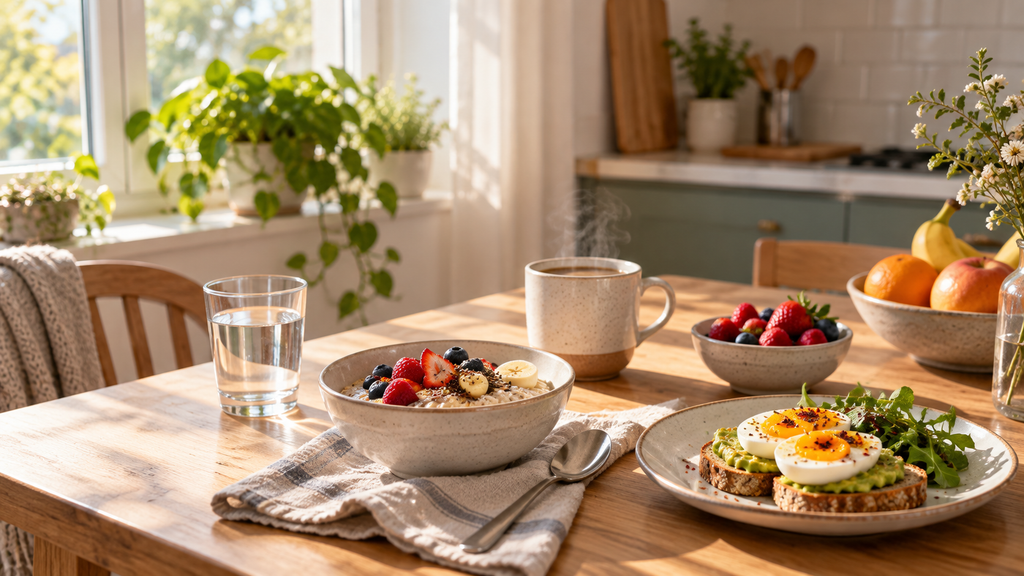
Breakfast does not need to be mandatory in a general wellness article.
Research on breakfast and health is more complicated than the familiar claim that breakfast is automatically “the most important meal of the day.” Randomized trials and observational studies do not support treating one eating schedule as universally appropriate for every adult.
If you normally eat breakfast, focus on making the meal nourishing rather than “perfect.”
Depending on your preferences and dietary needs, that could include a combination of:
- A protein-rich food.
- Fruit or vegetables.
- A source of fiber.
- Whole grains where appropriate.
- Unsaturated fats.
Examples include plain yogurt with fruit and oats; eggs with vegetables and whole-grain toast; oatmeal with fruit, nuts and yogurt; or leftovers from another balanced meal.
Current U.S. dietary guidance emphasizes nutrient-dense foods and overall eating patterns rather than special morning “detox” foods.
If you do not normally eat breakfast and feel well with a different meal schedule, a generic morning wellness article should not tell you otherwise.
Take Care of Basic Oral Hygiene
Morning wellness does not have to be glamorous.
Brushing your teeth is more foundational than many wellness rituals marketed online.
The American Dental Association recommends brushing twice daily for two minutes with fluoride toothpaste.
Tongue scraping can be optional, particularly for people concerned about tongue coating or bad breath. Reviews suggest possible benefits for oral malodor, but the evidence is much narrower than the evidence supporting routine tooth brushing.
Oral probiotics should not be presented as a standard requirement. Research continues, but benefits may depend on specific strains, products and dental outcomes.
Give Yourself a Brief Mental Reset
You do not have to meditate to have a mentally healthy morning.
Choose whichever short practice helps you transition into the day:
- Slow breathing.
- Brief meditation.
- Prayer if it is personally meaningful.
- Journaling.
- Gratitude.
- Quiet reflection.
- Sitting with your drink without immediately consuming notifications.
Mindfulness and meditation may help some people manage stress, but the evidence varies by technique and population, and the research is often less definitive than wellness marketing suggests.
Breathwork also has promising evidence. A meta-analysis of randomized trials found a small-to-medium reduction in self-reported stress, while the authors specifically urged caution about overstating the science.
So “take five slow breaths” is a reasonable option.
“Reset your nervous system in 60 seconds” is not responsible wording.
Be Intentional About Your Phone
You do not need a rule saying you can never look at a screen for the first hour of the day.
Some people need their phones immediately for:
- Family communication.
- Work.
- Public transportation.
- Accessibility.
- Medical devices.
- Emergency alerts.
- Childcare.
The more useful question is whether you are opening your phone on purpose.
Checking an essential message is different from automatically opening several apps and scrolling for 25 minutes.
If notifications tend to overwhelm you, consider keeping nonessential alerts silent until you are ready for them.
Decide What Matters Today
Finish your routine with a short orientation to the day.
This does not need to become a productivity system.
Try one of these:
Choose one to three priorities.
Check essential appointments.
Ask yourself what you need physically or mentally today.
Notice whether a demanding meeting, class or family responsibility may require extra preparation.
One minute is enough.
What About Popular Morning Wellness Trends?
Cold showers
Cold-water exposure has attracted enormous wellness attention, but the evidence does not make it an essential morning habit.
A 2025 systematic review found some time-dependent effects on stress, sleep and wellbeing, but the evidence base included relatively few randomized trials and limited populations. Cold exposure also creates physiological stress.
Sudden cold water can affect breathing, blood pressure and cardiovascular workload, which is especially relevant for people with certain health conditions.
If you enjoy a cool shower and it is safe for you, fine.
You do not need one for a legitimate morning wellness routine.
Grounding or earthing
Walking outside can be an excellent habit.
The claim that your bare feet need electrical contact with Earth for therapeutic effects is much less established.
Cleveland Clinic notes that the grounding/earthing research remains limited and much of it is too preliminary or methodologically weak to support strong medical claims.
Go outside because light, walking, fresh air or nature feels good to you.
You do not need to remove your shoes to make the walk count.
Affirmations and gratitude
Affirmations are optional.
A 2025 meta-analysis found small positive effects of self-affirmation interventions across several wellbeing outcomes, so the concept should not be dismissed entirely. But that evidence does not support the sweeping claim that repeating positive statements each morning will “rewire your brain.”
Use affirmations if they genuinely help you.
Do not treat them as a biological requirement.
Do Supplements Belong in a Morning Wellness Routine?
Not automatically.
A supplement may be appropriate when there is a specific nutritional need, life-stage indication or medical reason. But there is no evidence-based “morning stack” that every adult should take.
The NIH Office of Dietary Supplements advises that nutritional needs should generally be met primarily through food, while recognizing situations where supplementation may be useful.
The USPSTF also does not recommend a generic multivitamin or nutrient stack for healthy adults as a universal cardiovascular or cancer-prevention strategy; evidence is insufficient for many commonly used supplements.
That means vitamin D, B-complex vitamins, magnesium, fish oil, CoQ10 and ashwagandha should not be added merely because another person’s morning routine includes them.
Supplement decisions may depend on:
Diet.
Age.
Pregnancy.
Laboratory findings.
Medical conditions.
Medications.
Known deficiencies.
A clinician’s recommendation.
Timing can also matter for medications and supplements, so a general morning-routine article should never override individualized instructions.
How to Adapt Your Morning Wellness Routine
If you work from home
Use the commute time you no longer have as a short transition: get dressed, step outside or walk briefly before opening work.
If you commute
Combine habits. Walk part of the journey, carry water and prepare breakfast the night before if mornings are rushed.
If you are a parent or caregiver
Your routine may happen around other people’s needs. A two-minute stretch beside your child, daylight during school drop-off and a glass of water while breakfast is being prepared all count.
If you are a student
Prioritize sleep over building a long pre-class routine. Pack what you need at night and keep the morning version short.
If you work shifts
“Morning” means after your main sleep period, not necessarily 7 a.m. Light exposure and sleep timing can have different implications for shift workers, so rigid advice designed for daytime workers may not apply.
If you are an older adult
Movement can be adapted to balance, mobility and medical needs. WHO guidance specifically recognizes that physical activity should be adapted to ability and health status.
If you exercise later
Do not move your workout merely because an article calls morning exercise superior.
Regular activity is more important than copying a particular time slot.
If you do not eat breakfast
Do not force a meal solely to complete a checklist unless your health needs or professional guidance indicate otherwise.
If you have limited mobility
Movement might mean seated mobility, wheeling, physical therapy exercises or another accessible activity appropriate to your abilities.
The purpose is adaptation, not comparison.
How to Make Your Morning Routine Stick
Begin with only one to three changes.
Attach them to things that already happen.
For example:
After opening the curtains, drink some water.
After brushing your teeth, do one minute of mobility.
While coffee or tea is preparing, check your priorities.
Prepare anything that creates unnecessary friction the night before.
Keep an “easy version” for chaotic days.
And periodically ask whether the routine is actually helping. A ritual that creates stress every morning simply because an influencer recommended it is not serving its purpose.
There is no universal number of days after which a habit automatically becomes permanent.
A Better Morning Often Starts the Night Before

You do not need a complete evening wellness routine.
Just remove obvious obstacles.
Give yourself enough opportunity to sleep.
Put essential items where you can find them.
Prepare clothes if it saves time.
Prepare breakfast or lunch if mornings are rushed.
Charge necessary devices.
Decide what really has to happen before you leave.
A morning routine should reduce friction, not require waking an hour earlier to create more tasks.
Keep Medical Needs Separate From Generic Wellness Advice
A general morning wellness routine cannot account for every medical situation.
If a condition affects your sleep, hydration, diet, mobility, exercise tolerance or medication timing, follow individualized professional advice.
Lifestyle habits can support wellbeing.
They should not be used as substitutes for diagnosis, medication or treatment.
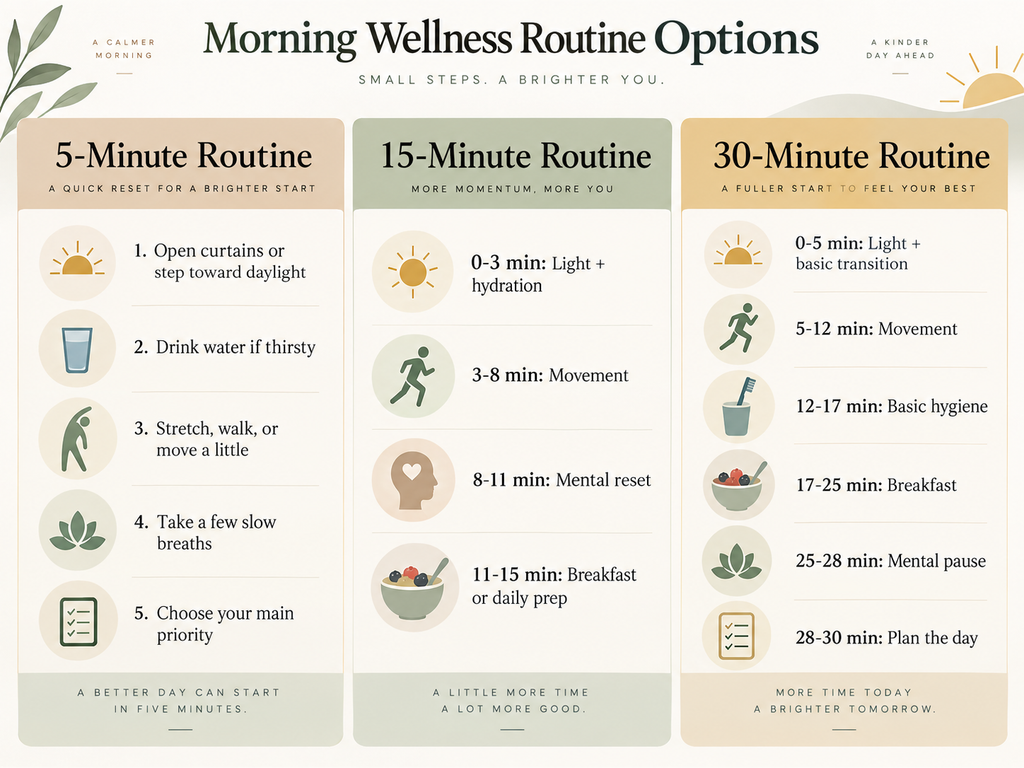
16. 5-Minute Morning Routine
This is the best fallback routine for readers who have almost no extra time.
Minute 1: Open the curtains and move toward daylight. Step outside briefly if practical.
Minute 2: Drink water if you are thirsty.
Minutes 3–4: Walk, stretch or do a few comfortable mobility movements.
Minute 5: Take a few slow breaths and decide the most important thing you need to remember today.
Five minutes does not replace adequate sleep, regular exercise, nourishing food or meaningful stress-management practices. Its value is that it provides a realistic baseline instead of an all-or-nothing routine.
17. 15-Minute Morning Routine
0–3 minutes:
Get up, open the curtains or move toward daylight, use the bathroom and drink something if you are thirsty.
3–8 minutes:
Take a short walk, stretch, do mobility work or another type of movement that feels appropriate.
8–11 minutes:
Use a brief mental pause: breathing, meditation, prayer, quiet reflection or journaling.
11–15 minutes:
Brush your teeth and prepare breakfast, gather essential belongings or identify your main priorities.
The minutes are organizational examples, not medically optimal intervals.
18. 30-Minute Morning Routine
A balanced 30-minute morning does not need to contain 10 wellness rituals.
0–5 minutes: Wake, get daylight, use the bathroom and drink according to thirst.
5–12 minutes: Complete gentle movement, a short walk or part of your planned workout.
12–17 minutes: Brush your teeth, wash and complete basic grooming.
17–25 minutes: Prepare or eat breakfast if you normally eat breakfast.
25–28 minutes: Take a short mental pause such as breathing, prayer, meditation or quiet reflection.
28–30 minutes: Check essential appointments and choose one to three priorities.
If your normal workout needs more time, move it elsewhere in your schedule instead of trying to force it into this template.
19. Busy-Morning Bare-Minimum Routine
When everything goes wrong, keep only three priorities:
1. Protect enough sleep.
Do not repeatedly sacrifice sleep to create a more impressive morning ritual.
2. Meet your basic physical needs.
Use the bathroom, complete essential hygiene, drink when thirsty and eat according to your normal needs.
3. Get daylight or movement when practical.
Walking to transportation, taking stairs where appropriate, opening the curtains or stepping outside for a moment all count.
A shortened routine is still a routine.
Missing meditation, journaling, skincare, cold exposure or a workout does not make your morning unhealthy.
20. FAQs
What is a good morning wellness routine?
A practical routine includes adequate sleep, a reasonably consistent wake time, daylight, fluids according to need, some movement, basic hygiene, breakfast if you normally eat it and a brief mental transition into the day.
What should I do first after waking up?
There is no medically required first action for every person. Getting up, allowing in daylight, using the bathroom and meeting basic hydration or hygiene needs are reasonable starting points.
How long should a morning wellness routine be?
As long as it can realistically fit your life without reducing sleep. Five minutes can provide a useful structure; 15 or 30 minutes gives you more room for movement, food preparation and relaxation.
Should I drink water immediately after waking?
You can, especially if you are thirsty. But there is no requirement to drink an exact amount the moment you wake up. Overall hydration across the day matters more. Fluid needs vary between people.
Is breakfast necessary every morning?
Not necessarily for every healthy adult. If you eat breakfast, prioritize nutrient-dense foods rather than assuming one meal timing works for everyone. Evidence around breakfast skipping includes both observational associations and randomized findings, so blanket claims are inappropriate.
Is exercise better in the morning?
Morning exercise can work very well for people who enjoy it or find it easier to schedule, but health organizations emphasize regular physical activity overall rather than one compulsory time of day.
Is morning sunlight good for your sleep schedule?
Light is an important circadian signal. Research has linked the timing of daylight exposure, including morning exposure, with aspects of sleep timing and quality, although evidence does not justify promising that a specific morning dose will improve everyone’s sleep.
Do I need to meditate in the morning?
No. Meditation can be useful for some people, but breathing, prayer, journaling, quiet reflection or simply avoiding unnecessary stimulation can fill the same practical role in a morning routine.
Are cold showers necessary for a healthy morning?
No. Cold exposure is optional, its general-wellness evidence is still limited, and it can create cardiovascular and breathing stress.
Do I need supplements in my morning routine?
No universal supplement stack is recommended for everybody. Supplement needs depend on diet, deficiencies, medical circumstances, medications and life stage.
How can I create a morning routine when I’m very busy?
Use a fallback version: daylight, basic physical needs and one minute of movement or mental preparation. Add longer practices only when they genuinely fit your schedule.
Read more: Daily Wellness Routine: Simple Habits From Morning to Night